What Are the Usual Insurance Limits for a 1,000 Sq Ft Condo in 2026?
Adams Kotel
Published on
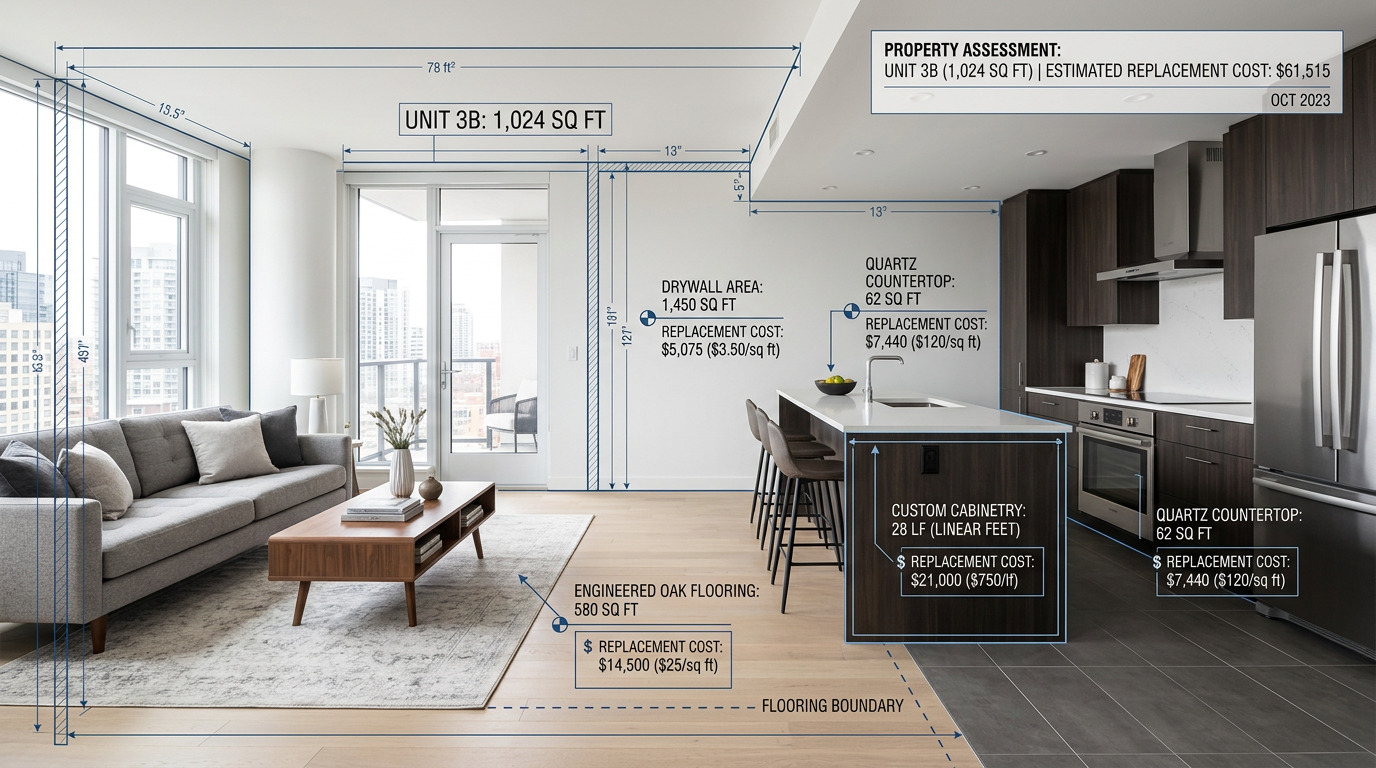
You have just closed on a beautiful 1,000-square-foot condominium. It is the perfect size—large enough to entertain, yet compact enough to avoid the relentless upkeep of a sprawling suburban estate. As you finalize your mortgage documents, your lender requires proof of an active HO-6 condominium insurance policy. You call an insurance agent or log onto a direct-to-consumer website to get a quote. The very first question the system asks you is the most critical and the most confusing: "How much Dwelling Coverage (Coverage A) do you need?"
You stare at the screen. You know you paid $450,000 to buy the condo, but you also know from our guide on Replacement Cost vs. Market Value that you shouldn't insure the real estate value. You search the internet, typing in exact, desperate queries: "What's the usual limits for a 1000 ft condo for homeowners?" or "How much dwelling coverage for 1100 square foot condo?"
The frustrating reality of 2026 is that the insurance industry rarely provides a straight answer to this question. Agents often throw out arbitrary "rules of thumb" like a flat $50,000 limit, or they rely on outdated software algorithms that haven't kept pace with the explosive inflation of construction labor and high-end finish materials. Guessing this number is a catastrophic financial risk. If a fire starts in your kitchen and guts your unit, a "guess" will likely leave you $60,000 short of the funds required to rebuild.
This exhaustive, 2,200-word masterclass is the definitive calculator for sizing your condo insurance. We will bypass the generic advice and drill down into the exact, square-foot mathematics required to insure a 1,000 to 1,500 sq ft condo. We will analyze the impact of builder-grade vs. luxury finishes, decode the strict boundaries of your HOA Master Policy, and provide the exact dollar-limit formulas you must use to protect your equity today.
Part 1: The Three Variables of the Condo Calculator
Before we can assign a dollar value to a 1,000-square-foot box, we must define exactly what that box contains. The required limit for Coverage A (Dwelling) is dictated by an equation involving three immovable variables. If you ignore any of these, your calculation will fail.
- The HOA Master Policy Boundary: What is the Homeowners Association legally required to rebuild?
- The Construction Cost per Square Foot: What do local contractors charge in 2026 to install drywall, flooring, and plumbing?
- The Grade of Finishes: Do you have basic carpet and laminate, or Brazilian cherry hardwood and imported marble?
Let us dissect each variable and apply the math.
Part 2: Variable 1—The HOA Master Policy Boundary
As we established in our highly cited guide, Studs-In vs. Studs-Out Condo Coverage, you cannot insure your condo until you know what the HOA is already insuring. You must request your HOA's Covenants, Conditions, and Restrictions (CC&Rs) today.
The CC&Rs will dictate one of three scenarios, which drastically alters your math for a 1,000 sq ft unit:
Scenario A: "All-In" (All-Inclusive)
The HOA’s Master Policy covers the entire building, including all interior walls, flooring, and cabinets, including any custom upgrades you have made.
- The 1,000 Sq Ft Math: Because the HOA rebuilds the interior, you need very little Coverage A.
- The Recommended Limit: $15,000 to $25,000. This serves merely as a "buffer" for minor disputes or specialty built-ins.
Scenario B: "Single Entity" (Original Specs)
The HOA covers the interior, but only as it was originally built by the developer. It does not cover your upgrades.
- The 1,000 Sq Ft Math: You must calculate the cost of "Betterments and Improvements." If you bought a 1,000 sq ft unit with original cheap carpet and upgraded it entirely to hardwood (let's estimate $15/sq ft installed), you have $15,000 in flooring upgrades. Add $20,000 for a kitchen remodel you did.
- The Recommended Limit: $35,000 to $50,000+ (The exact total cost of all upgrades).
Scenario C: "Bare Walls-In" (The Ultimate Threat)
The HOA builds the raw wooden frame and the concrete floor. They stop at the studs. You are responsible for everything inside the box.
- The 1,000 Sq Ft Math: This is the most dangerous scenario, requiring a full "gut-rebuild" calculation based on square footage. The rest of this guide will focus on this "Bare Walls" math, as it represents your maximum possible exposure.
Part 3: Variable 2 & 3—Calculating the "Bare Walls" Cost Per Square Foot
If you live in a "Bare Walls" complex, you must rebuild the interior of your 1,000 sq ft condo from scratch after a devastating fire or a catastrophic frozen pipe burst.
In 2026, the construction labor market is constrained, and material costs are high. You cannot use 2019 pricing metrics. You must apply the following regional and quality-based multipliers to your square footage.
(Note: These are 2026 national averages. Highly inflated coastal markets like San Francisco or Manhattan will require a 20% to 30% premium on these numbers).
Grade 1: The "Economy/Builder" Finish
- The Specs: Standard half-inch drywall, basic flat paint, entry-level carpet or vinyl plank flooring, laminate countertops, MDF cabinets, standard fiberglass tub/shower inserts.
- The 2026 Cost: $90 to $120 per square foot.
- The 1,000 Sq Ft Math: 1,000 x $110 = $110,000 Dwelling Limit.
Grade 2: The "Premium/Custom" Finish (Most Common)
- The Specs: High-quality engineered hardwood or tile flooring throughout, quartz or mid-tier granite countertops, solid wood or high-end veneer cabinets, stainless steel appliance packages, tiled showers with glass enclosures, upgraded trim and molding.
- The 2026 Cost: $140 to $180 per square foot.
- The 1,000 Sq Ft Math: 1,000 x $160 = $160,000 Dwelling Limit.
Grade 3: The "Luxury/Architectural" Finish
- The Specs: Exotic imported hardwood or natural stone flooring, rare slab marble or quartzite counters, custom-milled cabinetry, professional chef-grade appliances (Sub-Zero, Wolf), smart-home integrated lighting, custom millwork, and intricate bathroom stonework.
- The 2026 Cost: $225 to $350+ per square foot.
- The 1,000 Sq Ft Math: 1,000 x $275 = $275,000 Dwelling Limit.
The Verdict: For the vast majority of modern, well-maintained 1,000 sq ft condos in a "Bare Walls" HOA, a Coverage A limit of $50,000 is catastrophically inadequate. The mathematical reality dictates a limit between $120,000 and $180,000. If you have 1,500 sq ft, simply multiply your chosen grade by 1,500 (e.g., a 1,500 sq ft premium condo requires a $240,000 limit).
Part 4: The 20% "Code Upgrade" Multiplier
If you have calculated your "Bare Walls" limit at $160,000, you are not finished. You must account for the law.
If your condo building is more than 10 years old, it was not built to 2026 building codes. If a fire destroys your unit, the city inspector will demand that your new interior meets modern electrical, plumbing, and energy-efficiency standards. As we detailed in our essential guide, Why You Need Ordinance or Law Coverage, a standard policy will not pay for these legally mandated upgrades.
- The Action Step: You must add an Ordinance or Law Endorsement to your HO-6 policy. We recommend setting this at 10% to 25% of your Coverage A limit.
- The Safety Net: If your limit is $160,000, a 25% endorsement provides an extra $40,000 specifically to pay the electrician and plumber for the required code upgrades, ensuring your rebuild doesn't stall at the permit office.
Part 5: Personal Property (Coverage C)—The "Stuff" Inside the Box
Now that we have insured the walls, floors, and cabinets (Coverage A), we must insure the items you can carry out the front door. This is Coverage C (Personal Property).
A 1,000 sq ft condo is tightly packed. The "rule of thumb" for personal property is dangerously inaccurate. You must perform a visual home inventory.
- The 1,000 Sq Ft Average: In a typical 1,000 sq ft, 2-bedroom condo, the average resident possesses between $40,000 and $70,000 worth of furniture, clothing, electronics, kitchenware, and rugs.
- The Vital Endorsement: You must ensure your policy includes Replacement Cost Value (RCV) for Personal Property. If you have an Actual Cash Value (ACV) policy, the insurer will apply harsh depreciation, handing you $300 for a sofa that costs $1,500 to buy new.
- The Scheduled Items: Remember the "Theft Trap." As we exposed in What You Must Schedule on Your Home Policy, standard policies cap payouts for stolen jewelry, firearms, and cash at roughly $1,500. If you keep a $10,000 engagement ring or a rare coin collection in your condo, you must add a "Scheduled Personal Property" endorsement for those specific items.
Part 6: The "Master Deductible" Nightmare (Loss Assessment)
There is a final, highly volatile variable in the condo insurance equation that can ruin you, even if your Dwelling and Personal Property limits are perfect. It is the HOA Master Policy Deductible.
In 2026, HOA boards are facing unprecedented commercial insurance premiums. To save money, they are raising the deductibles on the building's Master Policy from a manageable $5,000 to punishing levels of $25,000, $50,000, or even $100,000.
- The Nightmare Scenario: A pipe in your wall bursts (a common peril leading to frequent water claims), causing $150,000 in damage to the building's common areas and neighboring units. The HOA files a claim on the Master Policy.
- The Chargeback: The Master Policy has a $50,000 deductible. Because the leak originated in your unit, the HOA bylaws likely give the board the right to assess that entire $50,000 deductible directly to you.
- The Shield: You must carry high limits of Loss Assessment Coverage. The standard $1,000 limit included in an HO-6 policy is a relic of the 1990s. You must call your independent broker today and increase your Loss Assessment limit to $50,000 (or whatever matches your HOA's Master Deductible). This endorsement is incredibly cheap (often $20-$40 a year) and is the ultimate firewall for condo owners.
Part 7: Renting It Out? The Math Changes Again
All of the math above assumes you live in the condo. If you move out and lease the 1,000 sq ft unit to a tenant, the HO-6 policy immediately becomes invalid for certain critical coverages.
As we detailed in our guide for investors, Converting Your HO-6 to a Landlord Policy, you must restructure the contract. While your "Bare Walls" Coverage A limit remains the same, your Coverage C (Personal Property) drops significantly (since you only need to cover appliances), and you must add "Fair Rental Value" coverage to ensure you continue receiving rental income if a fire forces your tenant to move out during the rebuild.
Conclusion: Engineering Your Financial Safety
Insuring a 1,000-square-foot condominium is an exercise in precise financial engineering. You cannot rely on the default settings of an online quoting tool, and you cannot assume the HOA has your best interests at heart. The "usual limits" suggested by untrained agents are almost always too low, designed to sell a cheap policy rather than secure your wealth.
By demanding a copy of your CC&Rs, establishing the "Bare Walls" boundary, honestly assessing the grade of your finishes, and multiplying by the 2026 cost of local labor, you can arrive at an exact, mathematically sound Coverage A limit. Fortify that limit with Ordinance or Law coverage, protect your belongings with Replacement Cost, and shield your savings from the HOA board with a massive Loss Assessment endorsement.
At Surety Insights, we believe that Clarity is Coverage. Do not let a $150,000 "Bare Walls" rebuild cost you your retirement. Perform your annual insurance audit today, verify your square footage math, and ensure the box you live in is surrounded by an impenetrable financial shield. Drive safe, calculate accurately, and stay covered.
Share this article
About the Author
Adams Kotel
Lead Insurance Analyst
Adams has over 15 years of experience in the insurance industry, specializing in personal line products. He is passionate about demystifying complex insurance topics and helping consumers make educated decisions.
Related Articles

How Much HO-6 Dwelling Coverage is Needed for a 2,053 Square Ft Condo? (A Mathematical Case Study)
Calculating condo insurance isn't a guessing game. We break down the exact math for a 2,053 sq ft luxury condo, explaining "Coverage A," local construction costs, and the dangers of underinsuring a high-end unit.
Adams Kotel

The HO-6 Policy Training Outline: A Masterclass for New Condo Owners
An structured, step-by-step training outline designed to take you from a condo insurance novice to an HO-6 expert. Learn to decode master policies, calculate coverage, and protect your equity.
Adams Kotel