The Theft Limitation Trap: What You Must Schedule on Your Home Policy
Adams Kotel
Published on
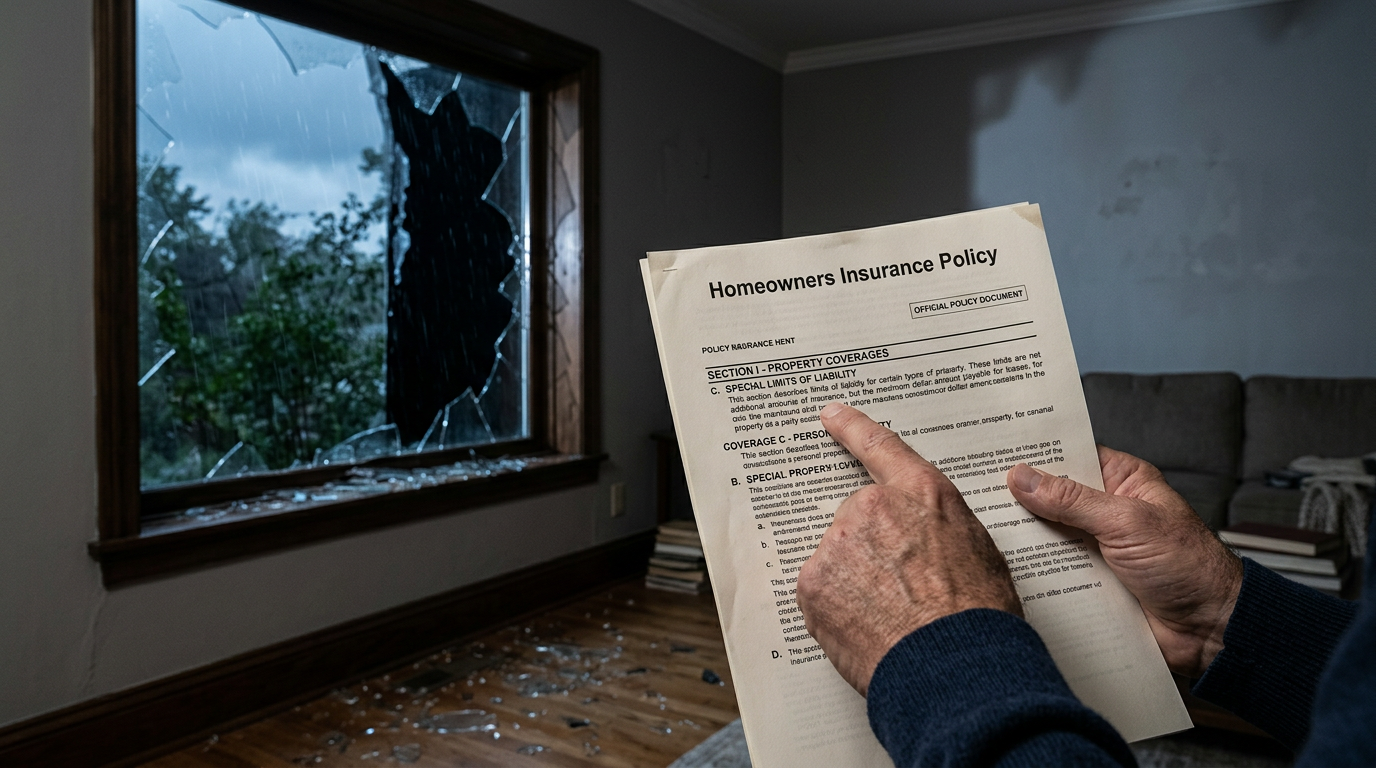
A home burglary is a profound violation of your personal sanctuary. Beyond the loss of physical property, it strips away your sense of safety and privacy. As you stand in the center of your ransacked living room, surveying the empty spaces where your television, your jewelry box, and your laptop used to be, you seek solace in one thought: "At least I have good homeowners insurance."
You call your independent agent to file the claim, expecting that your $200,000 "Personal Property" (Coverage C) limit will easily cover the $25,000 worth of stolen items. However, when the adjuster reviews your police report, they deliver a devastating secondary blow. While your television and laptop are fully covered, they point to a dense paragraph buried on page 14 of your policy contract. It is labeled "Special Limits of Liability."
Because of this clause, the $12,000 diamond ring that was stolen will only yield a payout of $1,500. The $3,000 in cash you kept in a fireproof safe? Capped at $200. The $5,000 collection of vintage shotguns? Capped at $2,500. Out of your $25,000 loss, the insurance company will only reimburse you $8,000.
This scenario is the "Theft Limitation Trap," and it catches thousands of American homeowners and renters off guard every year. Search data from Bing in 2026 reveals a surge of panicked consumers searching for a "list of valuables to schedule on a home policy due to theft limitations on coverage." They realize, often too late, that "blanket" coverage is an illusion when it comes to high-value, highly liquid assets.
This exhaustive, 2,200-word masterclass is your preemptive defense against this trap. Building on the foundational concepts introduced in our Ultimate Guide to Scheduled Personal Property, we will dissect the exact legal language of the "Special Limits" clause, explain why insurers cap these specific items, and provide a definitive, itemized checklist of the assets you must legally "schedule" to guarantee your financial recovery.
Part 1: The Actuarial Logic—Why Insurers Cap Theft Payouts
To understand why your policy contains these draconian limits, you must look at the risk through the eyes of an insurance underwriter in 2026.
The standard homeowners (HO-3), condo (HO-6), and renters (HO-4) policies were designed to cover the "average" American household. The premium you pay is based on the statistical likelihood of average items—like sofas, clothes, and standard appliances—being destroyed in a fire or stolen in a burglary.
However, certain items break this statistical model. Items like jewelry, cash, rare coins, and firearms share three specific characteristics that terrify insurance companies:
- High Value Density: They pack an enormous amount of monetary value into a very small physical footprint. A $30,000 watch can fit in a pocket.
- High Liquidity: They are incredibly easy for a thief to sell on the black market or at a pawn shop for untraceable cash.
- High Fraud Potential: It is very difficult for an insurance company to verify that a homeowner actually had $10,000 in cash hidden under their mattress after a fire, making these claims highly susceptible to exaggeration or outright fraud.
To protect their profit margins from these high-risk items, insurers instituted "Special Limits of Liability." These sub-limits act as an absolute ceiling on the payout for specific categories of property, regardless of your overall Coverage C limit.
Part 2: The Definitive List of "Special Limits" (The 2026 Baseline)
While limits can vary slightly between carriers, the Insurance Services Office (ISO) standardizes these exclusions across the vast majority of policies. If you have a standard, unendorsed policy, here is the harsh reality of your theft coverage.
(Note: These limits are aggregate totals per claim, not per item. If three watches are stolen, the total payout for all three combined is capped at the limit).
- Money, Bank Notes, Bullion, Gold, Silver, and Platinum: Capped at $200. (This includes cash hidden in a safe, rare coin collections, and precious metals).
- Securities, Accounts, Deeds, Passports, and Tickets: Capped at $1,500.
- Watercraft (including their trailers, furnishings, and engines): Capped at $1,500.
- Trailers (not used with watercraft): Capped at $1,500.
- Theft of Jewelry, Watches, Furs, and Precious/Semi-Precious Stones: Capped at $1,500.
- Theft of Firearms and Related Equipment: Capped at $2,500.
- Theft of Silverware, Goldware, Pewterware, and Tea Sets: Capped at $2,500.
- Property Used Primarily for Business Purposes (On Premises): Capped at $2,500.
- Property Used Primarily for Business Purposes (Off Premises): Capped at $1,500.
If you own items in these categories that exceed these limits, you are effectively uninsured for the difference. To protect them, you must use a Scheduled Personal Property (SPP) endorsement, which overrides the sub-limit and establishes an "Agreed Value" for the specific item based on a professional appraisal.
Part 3: The "Modern" Theft Gaps You Are Ignoring
The standard ISO limits listed above were written decades ago. In 2026, the modern household contains several new categories of high-value items that exist in a "gray area" of insurance coverage. These items frequently trigger massive claim disputes.
1. E-Bikes and High-End Bicycles
The surge in popularity of electric bicycles (e-bikes) has created a major insurance headache. A high-end e-bike can easily cost $4,000 to $8,000.
- The Trap: Because e-bikes have a motor, some aggressive insurance adjusters attempt to classify them as "motor vehicles," which are entirely excluded from homeowners insurance (they require an auto or motorcycle policy). Even if the policy explicitly covers "assisted bicycles," if the bike is stolen while chained outside a coffee shop, the "Off-Premises" limit may apply.
- The Solution: You must schedule a high-value e-bike on a specific sporting goods floater to guarantee coverage for theft, both at home and while commuting.
2. High-End Computing and "Business" Equipment
Since the remote-work revolution, the line between personal and business property has blurred.
- The Trap: You have a custom-built, $6,000 computer setup in your home office that you use for freelance graphic design. It is stolen. The adjuster points to the "Business Property" limit and caps the payout at $2,500 because the equipment is used for income generation.
- The Solution: Do not rely on personal property limits for business tools. You must schedule high-end business tech, or secure a specific commercial "In-Home Business" endorsement.
3. Designer Handbags and Sneaker Collections
The secondary market for luxury handbags (Hermès, Chanel) and limited-edition sneakers has exploded. A single bag can appreciate to $20,000.
- The Trap: While clothing is generally fully covered under Coverage C, most policies do not treat a $20,000 Birkin bag as "standard clothing." Without proof of purchase or an appraisal, an adjuster using Actual Cash Value (ACV) depreciation will value a 5-year-old bag at a fraction of its replacement cost.
- The Solution: Luxury "wearables" that appreciate or hold significant value must be scheduled with a certified appraisal to guarantee an "Agreed Value" payout.
4. Musical Instruments
If you own a $10,000 vintage Gibson guitar, it is fully covered by your standard policy—unless you use it to play paid gigs at a local bar on the weekends.
- The Trap: The moment you accept money for playing the instrument, it transitions to "Business Property," and the $2,500 cap applies.
- The Solution: Professional or semi-professional musicians must schedule their instruments. As an added benefit, scheduling often provides "broad form" coverage, which pays to repair the instrument if you accidentally drop and crack it (a peril not covered by standard home insurance).
Part 4: The "Mysterious Disappearance" Advantage
When deciding what to schedule, you must consider the cause of the loss, not just the value of the item.
A standard homeowners policy is a "Named Peril" policy for your personal property. It only covers your belongings if they are destroyed or lost due to specific events, such as fire, wind, or a documented, police-reported burglary.
The "Lost It" Scenario: You take off your $5,000 engagement ring to wash your hands at a restaurant and leave it on the sink. When you return 10 minutes later, it is gone.
- Standard Policy: Claim Denied. "Misplacing" an item or "Mysterious Disappearance" is not a covered peril on an HO-3 policy.
- Scheduled Policy: Claim Paid. When you schedule an item, the coverage changes from "Named Peril" to "Open Peril." It covers almost any type of loss, including accidentally losing the item down a drain or leaving it in a hotel room.
If an item is highly mobile and prone to being lost (rings, watches, hearing aids), scheduling it is the only way to secure true peace of mind.
Part 5: The "Zero Deductible" Financial Strategy
As we advocated in our ultimate guide to insurance deductibles, the smartest financial strategy in 2026 is to carry a very high deductible on your primary homeowners policy (e.g., $2,500 or $5,000) to keep your base premiums low, and use that policy only for catastrophic events.
However, if your $4,000 camera is stolen from your car, you do not want to pay a $2,500 deductible to get a $1,500 check.
This is the hidden genius of Scheduled Personal Property. Scheduled items almost universally carry a $0 deductible. If the $4,000 camera is scheduled and stolen, you receive a check for $4,000. By scheduling your "high-frequency loss" items (jewelry, cameras, laptops), you can confidently raise your primary home deductible to $5,000, saving hundreds of dollars a year in premiums while maintaining "first dollar" coverage on the items most likely to be stolen.
Part 6: How to Execute a Valuables Audit
Do not wait for a burglary to discover the limits of your policy. Follow this professional protocol to audit and protect your valuables today.
- The Video Walkthrough: As we advise in our guide to creating a home inventory, take your smartphone and record a slow, narrated video of your home. Open your jewelry box, your gun safe, and your tech drawers.
- The "Threshold" Test: Review the video. Identify any single item (or collection of items in the restricted categories) that exceeds $1,500 in value. These are your candidates for scheduling.
- Gather the Provenance: To schedule an item, the insurance company requires proof of value. For items purchased in the last 18 months, a detailed receipt is usually sufficient. For older items, heirlooms, or fine art, you must obtain a professional appraisal from a certified expert (e.g., a GIA-certified gemologist).
- Call Your Broker: Contact your independent broker and request a quote for a "Personal Articles Floater" or a schedule endorsement.
- Compare Standalone vs. Endorsement: Ask your broker if it is better to add the schedule to your existing home policy or to buy a "Standalone" policy from a specialty carrier like Jewelers Mutual. As we explored previously, a standalone policy protects your primary home insurance from a rate hike if you file a claim for a lost ring.
Conclusion: Closing the Wealth Gap
A standard homeowners policy is a blunt instrument designed to rebuild the physical structure of your life after a catastrophe. It is excellent at replacing drywall, standard sofas, and refrigerators. It is fundamentally ill-equipped to protect the concentrated wealth represented by your luxury goods, family heirlooms, and specialized collections.
The "Special Limits of Liability" are not a mistake; they are a deliberate firewall designed to protect insurance companies from the volatile risk of theft. If you ignore these limits, you are choosing to "self-insure" the most valuable items you own.
In 2026, protecting your net worth requires precision. By understanding the strict limitations of Coverage C, embracing the "Open Peril" advantages of a scheduled endorsement, and utilizing the $0 deductible strategy, you transform your insurance from a generic safety net into a customized financial vault. At Surety Insights, we believe that Clarity is Coverage. Audit your valuables, secure your appraisals, and guarantee that if a thief breaches your home, they cannot breach your financial security. Drive safe, audit well, and stay covered.
Share this article
About the Author
Adams Kotel
Lead Insurance Analyst
Adams has over 15 years of experience in the insurance industry, specializing in personal line products. He is passionate about demystifying complex insurance topics and helping consumers make educated decisions.
Related Articles

How Much HO-6 Dwelling Coverage is Needed for a 2,053 Square Ft Condo? (A Mathematical Case Study)
Calculating condo insurance isn't a guessing game. We break down the exact math for a 2,053 sq ft luxury condo, explaining "Coverage A," local construction costs, and the dangers of underinsuring a high-end unit.
Adams Kotel

The HO-6 Policy Training Outline: A Masterclass for New Condo Owners
An structured, step-by-step training outline designed to take you from a condo insurance novice to an HO-6 expert. Learn to decode master policies, calculate coverage, and protect your equity.
Adams Kotel