Water Backup vs. Flood Insurance: Decoding Basement Water Claims
Adams Kotel
Published on
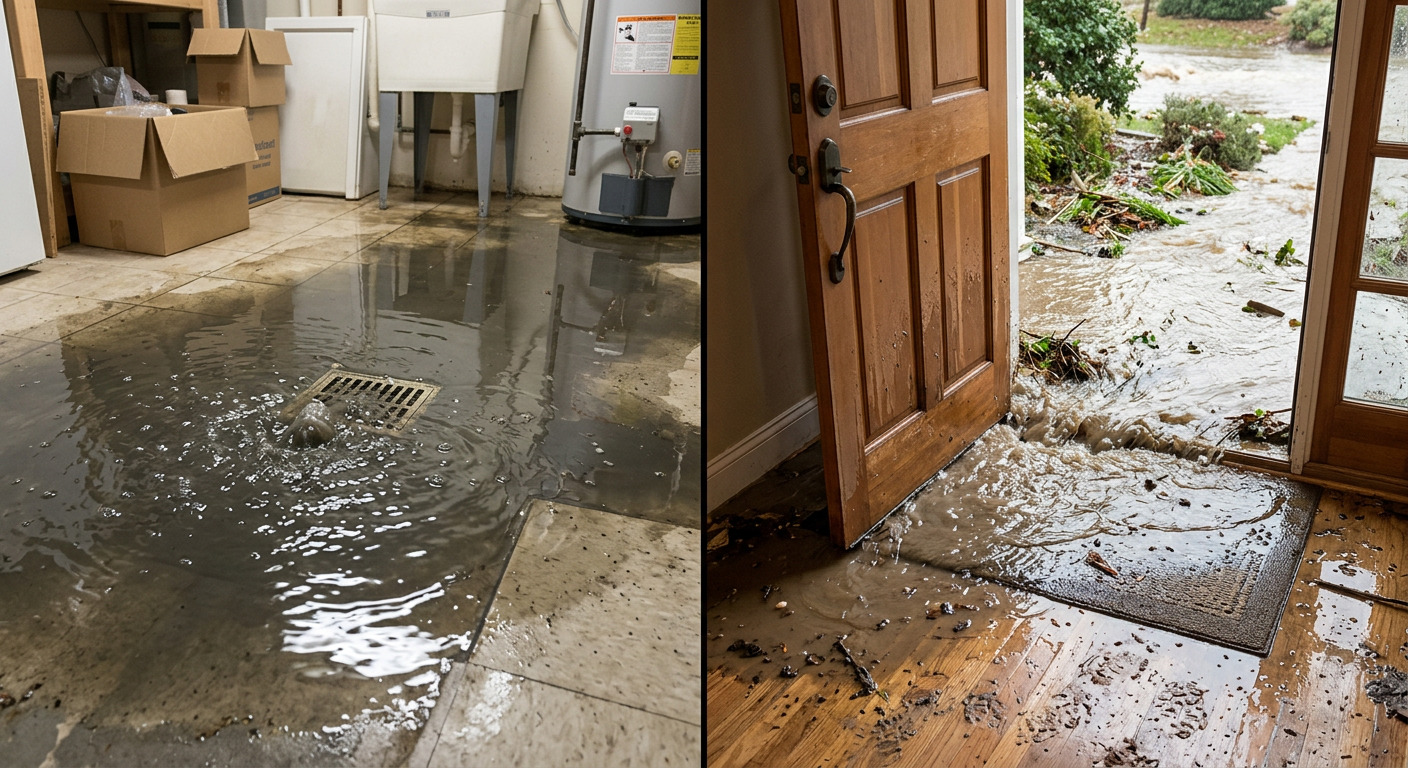
You wake up to the sound of torrential rain pounding against your roof. A massive, slow-moving storm system has been stalling over your region for two days, and the ground is entirely saturated. You walk downstairs to check on your finished basement—the space where you recently invested $30,000 in new drywall, carpeting, and a home theater setup. As your foot hits the bottom step, you hear a sickening "squish." The entire basement floor is covered in two inches of murky, foul-smelling water.
In a state of panic, you call a restoration company to begin pumping the water out, and then you call your insurance agent. You tell the agent, "My basement is flooded, I need to file a claim."
The agent pauses and asks a question that seems pedantic but is, in fact, the most legally significant question in the entire property insurance industry: "Exactly how did the water get into the basement?"
In 2026, as climate volatility drives an increase in severe, localized rain events (a trend we noted in our climate change insurance guide), millions of homeowners are facing this exact nightmare. Search queries from Bing reveal a massive wave of confusion: "does homeowners insurance cover outside ground water coming in?" and "will house insurance cover basement water cleanup?"
The harsh reality is that the insurance industry does not treat all water equally. The source and trajectory of the water dictate whether your standard homeowners policy will pay the $30,000 repair bill, or whether you will be left entirely on your own.
This exhaustive, 2,200-word masterclass will decode the hydrology of insurance claims. We will dissect the absolute exclusion of "Surface Water," explain the critical necessity of the "Water Backup" endorsement, and provide a strategic roadmap for protecting your home’s lowest level from the three primary vectors of water intrusion.
Part 1: The "Sudden and Accidental" Internal Leak (Covered)
To establish a baseline, we must review the one scenario where your standard HO-3 homeowners policy will reliably protect you without any special endorsements.
As we detailed in our foundational guide on The Silent Water Crisis, a standard policy covers water damage if it is the result of a "sudden and accidental discharge" from a plumbing, heating, or air conditioning system inside the home.
- The Scenario: The supply line to your basement washing machine suddenly ruptures, or your basement water heater catastrophically bursts, sending 50 gallons of clean water across the carpet.
- The Verdict: Covered. This is an internal, accidental failure. The insurance company will pay to tear out the wet carpet, dry the drywall, and replace the ruined flooring (subject to your standard deductible).
If the water came from a pipe inside the house that you own, you are generally safe. The nightmare begins when the water originates from outside the plumbing system.
Part 2: The "Surface Water" Exclusion (The Flood Trap)
This is the most common reason for a devastating claim denial following a heavy rainstorm. Every standard homeowners, condo, and renters policy in the United States contains an absolute, ironclad exclusion for "Water Damage."
In the policy definitions, "Water Damage" specifically refers to:
- Flood, surface water, waves, tidal water, overflow of a body of water.
- Water which backs up through sewers or drains.
- Water which exerts pressure on or seeps or leaks through a building, sidewalk, driveway, foundation, swimming pool or other structure.
Let’s focus on point number one: Surface Water.
- The Scenario: It rains heavily for three days. The ground becomes saturated, and a pool of water forms in your backyard. The water level rises, overtops your window well, and pours through the basement window, flooding the floor. Or, the water simply pools against the foundation and seeps under the back door.
- The Verdict: Denied.
- The Reason: This is legally defined as "Surface Water." As soon as rain hits the ground and begins to flow or pool before it is absorbed, it becomes surface water. Standard homeowners insurance never covers surface water.
The Only Solution: NFIP Flood Insurance
If you want protection against surface water, you must purchase a completely separate policy through the National Flood Insurance Program (NFIP) or a private flood insurance carrier.
Warning: Even if you have NFIP flood insurance, coverage for basements is notoriously restrictive. An NFIP policy generally only covers the building elements in a basement (the furnace, water heater, electrical panel, and drywall). It typically does not cover personal property, finished flooring (carpet/hardwood), or furniture located below ground level. Finishing a basement in a flood zone is a massive, uninsured financial risk.
Part 3: The "Water Backup" Endorsement (The Mandatory Shield)
If the water didn't come through the window, but instead bubbled up from the floor, you are dealing with a different peril entirely: Water Backup of Sewers or Drains.
The Scenario: During a heavy rainstorm, the municipal sewer system in your street becomes overwhelmed with stormwater. The pressure reverses, pushing raw, untreated sewage and stormwater backward through your lateral pipe, and it erupts out of the floor drain in your basement.
The Alternate Scenario: Your basement is equipped with a sump pump designed to push groundwater away from the foundation. The power goes out during a storm, the pump stops working, and the sump pit overflows, flooding the basement.
The Standard Verdict: Denied. (Remember point #2 of the water damage exclusion). A standard, unendorsed HO-3 policy explicitly excludes water that backs up through a sewer or drain, or overflows from a sump pump.
The Solution: The "Water Backup" Endorsement
Because this risk is so prevalent—especially in older neighborhoods with combined sanitary/storm sewer systems—almost every insurance carrier offers a specific endorsement you can buy to "add back" this coverage.
If you have a basement, a crawlspace with a sump pump, or if you live on the ground floor of a condo building, you must perform an annual insurance audit today to ensure you have the Water Backup and Sump Overflow Endorsement.
- The Cost: It is incredibly cheap, typically costing between $40 and $100 per year.
- The Limit: It is usually sold in specific dollar increments: $5,000, $10,000, or $25,000.
The $10,000 Sub-Limit Trap
Do not assume that simply having the endorsement is enough. If you have a fully finished basement with a home theater, custom bar, and plush carpet, a $5,000 limit is a mathematical joke.
- The Reality of Sewage: When a sewer backs up, it is "Category 3" (Black Water) contamination. The mitigation requires hazmat protocols. The remediation company must tear out the carpet, cut the drywall two feet up the wall, and sanitize the concrete. The cleanup bill alone can easily hit $8,000 to $10,000, before you even buy a single piece of replacement drywall.
- The Action Step: You must demand the highest limit your carrier offers—ideally $25,000 to $50,000. If your carrier caps this coverage at $5,000, you must call your independent broker and move your policy to a carrier that understands modern basement finishing costs.
Part 4: Seepage and Groundwater (The Slow Death)
There is a third vector of water intrusion that causes immense confusion: Groundwater Seepage.
- The Scenario: It rains steadily for a week. The hydrostatic pressure of the groundwater builds up against your foundation. The water doesn't come through a window, and it doesn't come up through a drain. Instead, it slowly "sweats" or seeps directly through the microscopic pores in the concrete foundation walls or the basement floor slab.
- The Verdict: Denied.
- The Reason: This hits point #3 of the exclusion (water which exerts pressure on or seeps through a foundation).
Neither a standard homeowners policy, a water backup endorsement, nor a standard NFIP flood policy covers hydrostatic seepage.
- The Only Solution: This is entirely a maintenance issue. You must invest in physical mitigation, such as installing interior French drains, applying specialized concrete sealants, or hiring a contractor to excavate the exterior foundation and apply a waterproof membrane. Insurance will not save you from a porous foundation.
Part 5: The "Service Line" Overlap
As we detailed in our comprehensive guide to Service Line Coverage, there is a critical distinction between the pipe inside your house and the pipe outside in your yard.
- If a tree root crushes the sewer line in your front yard, causing a blockage that forces sewage back into your basement, you need two endorsements to be fully covered:
- Service Line Coverage: Pays the $10,000 to dig up the front yard and fix the broken pipe.
- Water Backup Coverage: Pays the $15,000 to clean up and repair the ruined basement interior.
If you only have Water Backup, the insurer will fix the basement, but leave you with a $10,000 bill to fix the pipe in the yard. You must have both shields in place.
Part 6: How to File a Water Claim Successfully
The words you use during your first phone call to the claims department are critical. If you are unsure of the exact source of the water, do not guess. If you say the wrong trigger word, the adjuster will immediately deny the claim.
- Wrong: "My basement is flooded." (The adjuster hears "Surface Water Flood" and initiates a denial).
- Wrong: "Water is seeping through my walls." (The adjuster hears "Hydrostatic Seepage" and initiates a denial).
- Right: "I have standing water in my basement. It appears to be coming from the floor drain / sump pump pit / a burst pipe. I need to open a claim and dispatch a water mitigation team immediately."
Let the professional mitigation company and the insurance adjuster determine the exact source. As we advised in our guide to The Mold Trap, your primary duty is to stop the water and start the drying process immediately to prevent secondary fungal growth.
Conclusion: Engineering a Dry Defense
A finished basement is a fantastic addition to a home's square footage and resale value, but it is fundamentally unnatural. You are placing expensive, sensitive materials—drywall, electronics, and carpet—into a concrete box buried in the damp earth. The laws of physics dictate that water will always seek the lowest point, and eventually, it will find a way in.
In 2026, relying on a generic homeowners insurance policy to protect a below-grade living space is a gamble with devastating odds. The industry has constructed rigid exclusions for surface water, sewage backup, and hydrostatic seepage to protect their profit margins from the inevitability of gravity and rain.
To protect your equity, you must move from being a passive policyholder to a proactive risk manager. Verify your elevation in a FEMA flood zone map. Ensure your sump pump has a battery backup system. Above all, perform a surgical audit of your declarations page today. Demand the Water Backup and Sump Overflow Endorsement, and push the limit to at least $25,000.
At Surety Insights, we believe that Clarity is Coverage. Understanding the precise hydrological boundary lines of your insurance contract ensures that when the rain stops and the water recedes, your financial foundation remains as solid as the concrete beneath your feet. Drive safe, check your drains, and stay covered.
Share this article
About the Author
Adams Kotel
Lead Insurance Analyst
Adams has over 15 years of experience in the insurance industry, specializing in personal line products. He is passionate about demystifying complex insurance topics and helping consumers make educated decisions.
Related Articles

How Much HO-6 Dwelling Coverage is Needed for a 2,053 Square Ft Condo? (A Mathematical Case Study)
Calculating condo insurance isn't a guessing game. We break down the exact math for a 2,053 sq ft luxury condo, explaining "Coverage A," local construction costs, and the dangers of underinsuring a high-end unit.
Adams Kotel

The HO-6 Policy Training Outline: A Masterclass for New Condo Owners
An structured, step-by-step training outline designed to take you from a condo insurance novice to an HO-6 expert. Learn to decode master policies, calculate coverage, and protect your equity.
Adams Kotel