The Credit Score Penalty: Why Your Financial Past Dictates Your Car Insurance
Marcus Seneki
Published on
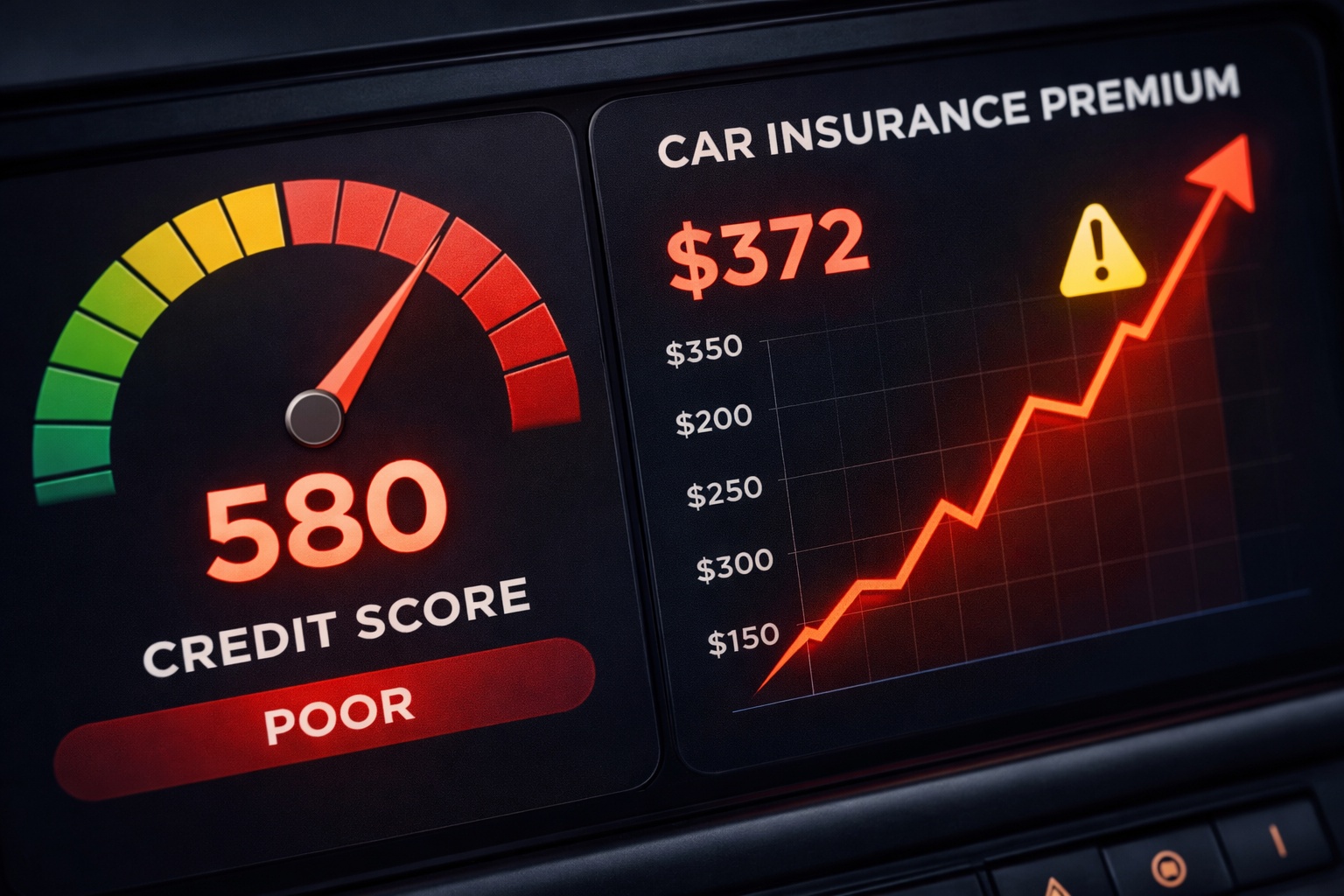
It is one of the most frustrating and counterintuitive experiences in the modern American financial system. You have been a model citizen behind the wheel. You haven't received a speeding ticket in a decade, you have never filed an at-fault accident claim, and you drive a safe, sensible sedan. Yet, when you open your auto insurance renewal notice or attempt to shop for a new policy, the premium quoted is astronomically high. You call your agent, demanding an explanation for the surge, expecting to hear about the rising cost of auto parts or the labor shortage. Instead, the agent hesitates and points to a completely unrelated metric: your credit history.
Search data in 2026 reveals a surge of confused and angry consumers asking the exact same question: "Do your car insurance rates depend on your credit score?"
The short, brutal answer for the vast majority of Americans is: Yes. Heavily.
In fact, outside of a handful of states that have banned the practice, your credit history is often a more significant factor in determining your auto insurance premium than your actual driving record. A driver with a flawless driving history but "Poor" credit will frequently pay significantly more—sometimes double or triple—than a driver with a recent DUI conviction but "Excellent" credit.
To the average consumer, this feels deeply unfair and entirely illogical. What does a late credit card payment or high student loan debt have to do with your ability to merge safely onto a highway? Why is the insurance industry punishing people for financial distress?
This exhaustive, guide will pull back the curtain on this controversial practice. We will dissect the actuarial science behind the Credit-Based Insurance Score (CBIS), explain exactly what insurers are measuring, detail which states have outlawed the practice, and provide a strategic roadmap for improving your score and fighting back against the "Credit Penalty."
Part 1: The Actuarial Justification—Why Insurers Care About Your Debt
Insurance is, at its core, the business of predicting the future based on the data of the past. When an underwriter is deciding how much to charge you, they are trying to answer one specific question: What is the statistical probability that this individual will file a claim that costs us money?
For decades, insurers relied on traditional proxies like age, gender, marital status, and driving history. However, in the 1990s, the Fair Isaac Corporation (FICO) introduced a new metric specifically for the insurance industry: the Credit-Based Insurance Score (CBIS).
Insurance companies ran massive data models correlating credit histories with claims data, and the results were staggering. The actuarial data demonstrated an undeniable, powerful correlation: Individuals with lower credit scores file significantly more claims, and those claims are statistically more expensive, than individuals with higher credit scores.
The Theory Behind the Math
Insurers do not claim that a low credit score causes bad driving. They argue that a low credit score is a highly accurate predictor of risk. The industry posits several behavioral theories to explain this correlation:
- The "Responsibility" Proxy: Insurers argue that how a person manages their financial obligations is indicative of how they manage other aspects of their life, including driving and vehicle maintenance. A person who is meticulous about paying bills on time is statistically more likely to be meticulous about checking their tire pressure, replacing worn brakes, and obeying speed limits.
- The "Stress and Distraction" Factor: Financial distress is psychologically taxing. Studies suggest that individuals dealing with overwhelming debt or collection calls are more likely to be distracted behind the wheel, leading to a higher frequency of accidents.
- The "Deferred Maintenance" Risk: If you are struggling to pay minimum balances on credit cards, you are less likely to spend $800 on a new set of tires or $200 to fix a faulty sensor. Deferring maintenance directly increases the likelihood of a catastrophic failure on the road.
- The "Claim Frequency" Economic Reality: A homeowner with $20,000 in savings might pay out-of-pocket to fix a minor $1,200 fender-bender to avoid a rate hike (a strategy we advocate for in our guide to the zero-claim strategy). A driver living paycheck-to-paycheck cannot afford that $1,200 and will therefore file a claim against their policy, driving up the insurer's frequency costs.
Because this correlation is mathematically proven across millions of data points, state insurance regulators (with a few notable exceptions) allow insurance companies to use credit data as a primary rating factor.
Part 2: FICO vs. CBIS—Understanding the Difference
It is vital to understand that your Credit-Based Insurance Score (CBIS) is not the same as the FICO score your mortgage lender or credit card company sees.
When you apply for a loan, the bank wants to know the probability that you will default on the debt. When you apply for auto insurance, the carrier wants to know the probability of an expensive accident. While both scores use the exact same underlying data from your credit report (Equifax, Experian, or TransUnion), they weigh the data differently.
What Matters Most to Your Insurance Score?
The CBIS algorithm heavily penalizes behaviors that suggest financial instability or desperation.
- Payment History (Approx. 40% of the score): This is the heaviest factor. Late payments, accounts sent to collections, foreclosures, and bankruptcies are massive red flags. They suggest a breakdown in financial control.
- Outstanding Debt / Credit Utilization (Approx. 30%): How much you owe compared to your available credit limits. If your credit cards are maxed out, your CBIS will plummet, as it indicates financial distress.
- Length of Credit History (Approx. 15%): A long, stable history of managing credit is viewed favorably. A "thin file" (someone with very little credit history) is penalized because the insurer has no data to prove stability.
- New Credit Applications (Approx. 10%): Opening several new credit cards or loans in a short period suggests you are suddenly desperate for cash, which the algorithm views as a high-risk indicator.
- Types of Credit (Approx. 5%): A healthy mix of installment loans (like a mortgage or auto loan) and revolving credit (credit cards) is preferred over a wallet full of high-interest retail store cards.
Crucial Note: Unlike applying for a mortgage, when an insurance company pulls your credit report to generate a quote, it is considered a "Soft Pull." It does not lower your traditional FICO score or appear as an inquiry to other lenders. You can shop for auto insurance quotes without damaging your credit.
Part 3: The "Credit Penalty"—How Much Does It Actually Cost?
The financial impact of a poor credit score is staggering. In the 2026 auto insurance market, the "Credit Penalty" is often the single largest variable on a premium quote, eclipsing even a recent at-fault accident.
According to national aggregate data from industry watchdogs:
- A driver with "Excellent" credit pays the base baseline rate.
- A driver with "Good" credit pays roughly 15% to 25% more than the baseline.
- A driver with "Fair" credit pays roughly 40% to 60% more than the baseline.
- A driver with "Poor" credit pays an astonishing 100% to 150% more than the baseline rate.
Let’s contextualize this: If a driver with an 800 credit score pays $1,200 a year for full coverage, a driver with the exact same car, age, and clean driving record but a 550 credit score could be quoted $3,000 a year.
This pricing disparity is the source of intense consumer advocacy pushback. Critics argue that the CBIS acts as an indirect, systemic tax on the poor, disproportionately affecting minority communities and those who have suffered medical emergencies or job losses. They argue it creates a vicious cycle: you lose your job, your credit score drops, your car insurance doubles, you can't afford the insurance, you lose your car, and you can't get to a new job.
Part 4: The Legal Map—Which States Have Banned CBIS?
In response to the equity concerns raised by consumer advocates, a growing number of state legislatures and insurance commissioners have intervened to restrict or completely ban the use of credit data in auto insurance pricing.
If you live in one of the following states in 2026, your credit score cannot be used to determine your auto insurance rate:
- California (Complete ban on credit scoring for auto insurance).
- Hawaii (Complete ban).
- Massachusetts (Complete ban).
- Michigan (Complete ban).
Several other states have implemented partial restrictions:
- Maryland, Oregon, and Utah restrict the use of credit scores in certain specific scenarios (e.g., they cannot use credit to cancel a policy or refuse to renew, or they restrict its use in setting base rates).
- Washington temporarily banned the practice, but the legal battles over the ban have been ongoing and complex.
If you live in one of the 45+ states where CBIS is fully legal (like Texas, Florida, or New York), your credit is actively determining your premium today.
Part 5: The "Extraordinary Life Event" Exemption
What if your credit was ruined by a massive, unexpected tragedy that had nothing to do with your financial responsibility?
The insurance industry, recognizing the PR nightmare of penalizing victims, adopted a model act known as the "Extraordinary Life Event" (ELE) Exemption. If your credit score dropped due to a specific, catastrophic event, you have the right to petition your insurance company to "suppress" the credit penalty and rate you as if you had "neutral" credit.
Common Valid ELEs Include:
- A catastrophic medical event or illness resulting in massive medical debt (a risk we discussed in our guide to medical billing errors).
- The death of a spouse, child, or parent.
- A temporary loss of employment lasting 3 months or more.
- Divorce or the dissolution of a marriage.
- Military deployment overseas.
- Identity theft (which highlights the importance of the personal cyber insurance we strongly recommend).
How to Execute an ELE: You must submit a formal, written request to your insurance carrier (often within 60 days of a renewal or new application) providing documentation of the event (e.g., hospital bills, a death certificate, or a police report for identity theft). The insurer is legally required to review the request and, if approved, recalculate your premium without the negative credit data.
Part 6: Strategic Defense—How to Beat the Credit Penalty
If you are trapped in a state that allows credit scoring and you are suffering from a "Fair" or "Poor" score, you cannot simply wait for your credit to heal (which can take years). You must take aggressive, immediate action to lower your insurance costs.
1. Adopt Telematics (The Great Equalizer)
If your credit score says you are a "high risk," but you know you are a safe driver, you must prove it. As we detailed in our guide to usage-based insurance and telematics, programs like Snapshot or Drive Safe & Save track your actual driving behavior (speed, braking, phone distraction).
- The Strategy: Earning a 30% discount through a telematics program is the most effective way to directly offset a 30% credit penalty. You are substituting bad financial data with good driving data.
2. Shop Constantly with an Independent Broker
Every insurance company uses a different, proprietary algorithm. Carrier A might penalize a 620 credit score by 40%, while Carrier B might only penalize it by 15%.
- The Strategy: You cannot afford "brand loyalty" when you have poor credit. You must work with an independent broker who can run your profile through 20 different carriers to find the one whose algorithm is the most forgiving of your specific credit profile.
3. The Power of "Non-Standard" Carriers
If major carriers (like State Farm or Allstate) are quoting you astronomical rates due to credit, your broker should look at the "Non-Standard" market (carriers like The General, Bristol West, or Dairyland). While these carriers specialize in high-risk drivers requiring SR-22s, they also cater to drivers with poor credit, often weighting the credit score much less heavily than the "preferred" carriers do.
4. The "No Credit Check" Illusion
Be wary of small, localized insurance agencies advertising "No Credit Check Auto Insurance." While they exist, they generally assume the absolute worst-case scenario and charge you the highest possible "default" rate anyway. It is almost always better to get a quote that pulls your credit, as even a "Poor" score might result in a better rate than the "No Data" assumption.
Conclusion: Actively Managing Your Data
The reality of the 2026 auto insurance market is that you are no longer just a driver; you are a data set. The insurance industry has determined that your financial past is a highly profitable predictor of your driving future. While consumer advocates continue to fight the ethics of the Credit-Based Insurance Score, the math remains the governing law in 45 states.
You cannot afford to ignore this reality. You must view your credit score not just as a tool for securing a mortgage or a low-interest credit card, but as a critical component of your daily cost of living. Every late payment is essentially a future premium increase.
However, you are not powerless. By understanding the specific metrics that drive the CBIS, utilizing the Extraordinary Life Event exemption if tragedy strikes, and leveraging telematics and aggressive shopping strategies, you can mitigate the "Credit Penalty."
At Surety Insights, we believe that Clarity is Coverage. Don't let a faceless algorithm dictate your financial stability without a fight. Perform an insurance audit today, pull your free annual credit report, and start actively managing the data that is determining your rate. The road to affordable insurance begins long before you turn the key in the ignition. Drive safe, manage your debt, and stay covered.
Share this article
About the Author
Marcus Seneki
Auto Liability Expert
Marcus brings a legal background to insurance, focusing on liability, state regulations, and the fine print of auto policies. He helps drivers understand the legal implications of their coverage choices.
Related Articles

Usage-Based Car Insurance Apps: Are They Really Worth It in 2026?
Car insurance apps promise massive discounts if you let them track your driving. But how accurate are they at detecting hard braking or phone use? We analyze the data, privacy risks, and real-world savings in 2026 to see if UBI apps are worth it.
Josef Bako
The Named Driver Exclusion: Saving Your Auto Insurance Rate
Is a high-risk roommate or a teenager with a DUI ruining your car insurance rate? Learn how the "Named Driver Exclusion" can instantly lower your premium—and the catastrophic risks of using it incorrectly.
Marcus Seneki