The Named Driver Exclusion: Saving Your Auto Insurance Rate
Marcus Seneki
Published on
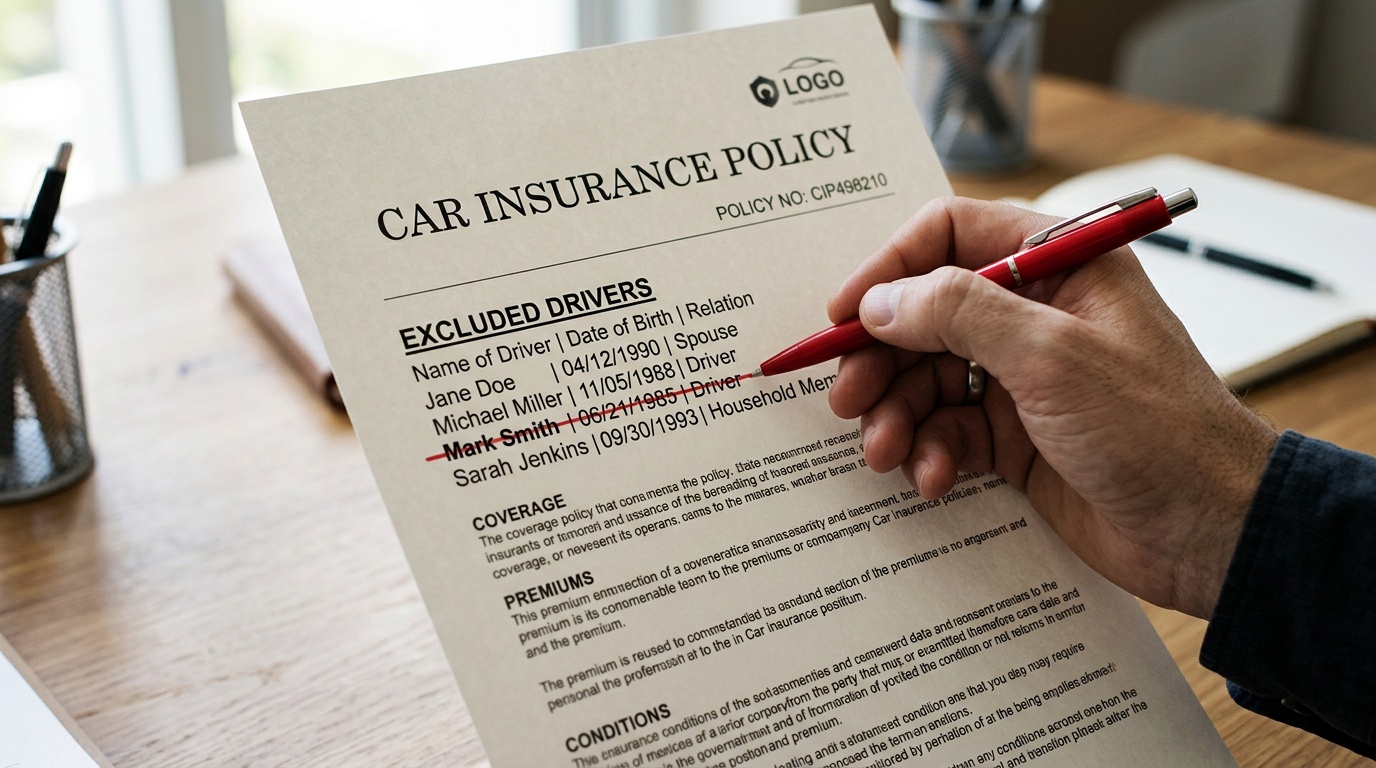
When calculating your auto insurance premium, underwriters do not operate in a vacuum. They don't just look at you; they look at your entire environment. As we explored in our guide to the key factors affecting your car insurance, one of the most inflexible rules in the insurance industry is the "Household Rule." Insurance companies generally require that every licensed driver living at your address be listed on your auto policy, regardless of whether they actually drive your car.
The actuarial logic behind this is simple: if the keys are on the kitchen counter, there is a statistical probability that a roommate, spouse, or child will eventually grab them to run a quick errand. To an insurance company, "access" equals "exposure."
For many households, this rule is a minor administrative detail. But for others, it is a financial nightmare. What happens if your 22-year-old son moves back home after receiving a DUI? What if your new roommate has a terrible credit score (which we know triggers a massive insurance penalty) and three recent at-fault accidents? What if you are housing an elderly parent who refuses to surrender their license but shouldn't be driving?
Because their address is now your address, the insurance company's algorithm will blend their high-risk profile into your policy. Your premium could double, triple, or result in a total non-renewal, penalizing you for a risk you didn't create.
Fortunately, in the majority of U.S. states, there is a surgical tool designed to amputate this specific risk from your policy: the Named Driver Exclusion (NDE). This 2,200-word masterclass will dissect the mechanics of the NDE. We will explain how this legal endorsement instantly lowers your rate, explore the strict legal definitions of "permissive use," and warn you about the catastrophic, potentially bankrupting consequences of violating the terms of an exclusion.
Part 1: The Anatomy of the Named Driver Exclusion
A Named Driver Exclusion is not a casual verbal agreement with your agent; it is a legally binding, signed amendment to your insurance contract.
When you sign a Named Driver Exclusion endorsement (often coded as form 515A or similar, depending on the carrier), you are making an absolute, unequivocal pact with the insurance company. You are stating: "I guarantee that [Name of Individual] will NEVER, under any circumstances, operate any of the vehicles insured on this policy."
In exchange for this ironclad guarantee, the insurance company completely ignores that individual's driving record, age, and high-risk status when calculating your premium.
The Financial Impact
The savings generated by an NDE can be life-changing.
- The Scenario: A married couple with clean records pays $1,500 a year for two cars. Their 19-year-old son, who recently totaled a car, moves back home. Adding him to the policy spikes the rate to $4,800.
- The Solution: The parents force the son to buy his own "beater" car and his own (expensive) insurance policy. The parents then sign a Named Driver Exclusion for the son on their policy. Their premium instantly drops back down to $1,500.
Part 2: The Absolute Nature of the Exclusion (No Exceptions)
The most dangerous aspect of the Named Driver Exclusion is that consumers frequently misunderstand its rigidity. People often assume that "insurance follows the car" and that the concept of Permissive Use will protect them.
- Permissive Use (The Standard Rule): Generally, if you let a friend borrow your car to run to the grocery store, your insurance covers them. Your policy extends to anyone using the vehicle with your permission.
- The NDE Override: A Named Driver Exclusion completely annihilates Permissive Use for that specific individual. It overrides the entire policy.
There are NO EXCEPTIONS to a Named Driver Exclusion.
- What if there is a medical emergency and they have to drive me to the hospital? Excluded.
- What if they only drove the car ten feet to move it out of the driveway so I could get out? Excluded.
- What if they took the keys without my permission while I was sleeping? Excluded. (In this case, the only way the insurer might pay for the damage to your car is if you formally press felony grand theft charges against your family member or roommate).
If the excluded driver is behind the wheel and causes an accident, your insurance policy effectively ceases to exist.
Part 3: The Catastrophic Consequences of a Violation
If you sign an NDE to save money, but you occasionally allow the excluded driver to use the car "just for quick trips," you are playing a game of financial Russian Roulette. If they cause an accident, the fallout is devastating and multi-tiered.
1. Zero Liability Coverage
If the excluded driver runs a red light and paralyzes another driver, your insurance company will immediately deny the claim. They will not pay the victim's medical bills, and more importantly, they will invoke the exclusion to deny their "Duty to Defend" you. You will be forced to hire your own defense attorney.
2. The Personal Asset Wipeout
Because the insurance company denied the claim, the victim's lawyer will sue the excluded driver. But they will also sue YOU, the owner of the vehicle, under the legal theory of "Negligent Entrustment" (arguing you were negligent for leaving the keys accessible to a dangerous, excluded driver). If you own a home, have a 401(k), or have future wages, they are all at risk. Furthermore, your Personal Umbrella Policy will also deny the claim, as it requires the underlying auto policy to be active.
3. Zero Physical Damage Coverage
If the excluded driver totals your $40,000 SUV, your Collision Coverage is void. The insurer will not pay to fix or replace your car. If you have a car loan, you will still owe the bank $40,000 for a destroyed vehicle. And no, your Gap Insurance will not save you, because Gap requires an active primary collision payout to trigger.
4. Policy Cancellation and Blacklisting
Once the insurance company discovers you violated the exclusion, they will likely cancel your policy immediately for material misrepresentation. You will be forced into the high-risk, non-standard market for your future insurance needs.
Part 4: State Laws—Where Are NDEs Illegal?
Because the consequences of an uninsured accident are so severe for the public (leaving victims with no way to pay their medical bills), several states have decided that Named Driver Exclusions are against public policy.
In 2026, you cannot use a Named Driver Exclusion in the following states (laws are subject to change, so always verify with your local independent broker):
- New York
- Wisconsin
- Michigan
- Kansas
- Virginia (Highly restricted)
In these states, insurers operate under the assumption that if you live together, the risk is shared. If you have a high-risk driver in your household in these states, your only options are to pay the inflated premium, force them to surrender their driver's license (which usually removes the requirement to rate them), or require them to move to a different address.
Part 5: The "Broad Form" Exclusion Trap
When reviewing your policy during your annual insurance audit, you must be precise about the type of exclusion you are signing.
Most NDEs are specific: "John Doe is excluded from driving the 2024 Honda Accord."
However, some non-standard carriers use a "Broad Form Named Driver Exclusion." This is a much more dangerous document. It states that the excluded driver is not covered while driving any car on the policy, AND that the policy will not provide coverage if the excluded driver is driving a different car (like a rental car or a friend's car). You must read the exact wording of the endorsement.
Part 6: How to Execute an Exclusion Properly
If you have weighed the risks and decided that an NDE is the only way to keep your household budget afloat, you must execute it with surgical precision.
Step 1: Secure Alternative Transportation
Do not exclude a driver who actually needs to drive. If your roommate or child needs a car for work, they must purchase their own vehicle and secure their own policy (even a basic liability-only policy from a high-risk carrier) before you sign the exclusion.
Step 2: The "Proof of Other Insurance"
Some preferred carriers (like State Farm or Travelers) will not allow you to simply exclude a licensed household member to save money. They will demand proof that the individual has their own active auto insurance policy elsewhere. You will need to provide the declaration page of their new policy before your underwriter will approve the exclusion.
Step 3: Physical Key Control
This is the practical reality of the exclusion. If you exclude your teenager, you cannot leave your car keys hanging by the front door. You must treat those keys like a loaded weapon. If they grab them in a moment of poor judgment, you lose your financial empire. Keep the keys in your bedroom or a lockbox.
Step 4: The "Surrender" Option
If you are housing an elderly parent whose cognitive or physical abilities have declined, the most compassionate and financially secure option is often to have them formally surrender their driver's license to the DMV and obtain a State ID card. Once they are no longer a licensed driver, the insurance company will remove them from the policy rating entirely, and you do not need to sign a dangerous NDE.
Part 7: Removing the Exclusion
An NDE is not necessarily permanent. As circumstances change, you must update your policy.
- The Timeline: If your child was excluded because of a high-risk teen profile, but they have now matured, maintained a clean record for three years on their own policy, and their credit score has improved, you can call your agent and request the exclusion be removed.
- The Re-Rating: The insurer will pull their new MVR (Motor Vehicle Record) and C.L.U.E. report. If the profile is acceptable, they will be added back as a covered driver, restoring your peace of mind and allowing them to borrow your car legally.
Conclusion: A Tool of Last Resort
The Named Driver Exclusion is the nuclear option of auto insurance risk management. It is a highly effective tool for surgically removing a toxic risk profile from your household insurance bill, potentially saving you thousands of dollars a year. However, it is a tool that requires absolute, unforgiving discipline to use safely.
In 2026, the cost of a car accident is too high to rely on "gentleman's agreements" with roommates or rebellious teenagers. If you sign an exclusion, you must enforce it with zero tolerance. Understand that you are trading the broad safety net of Permissive Use for a lower monthly premium.
If you are facing a massive rate hike due to a household member, perform your insurance audit today. Consult with a professional broker to see if an NDE is legal in your state and appropriate for your situation. But never forget the fundamental rule of the exclusion: if their name is on the list, they can never be behind the wheel. Drive safe, manage your keys, and ensure your liability shield remains unbroken.
Share this article
About the Author
Marcus Seneki
Auto Liability Expert
Marcus brings a legal background to insurance, focusing on liability, state regulations, and the fine print of auto policies. He helps drivers understand the legal implications of their coverage choices.
