The Uninsured Motorist Crisis: Why UM/UIM Coverage is Your Only Defense
Josef Bako
Published on
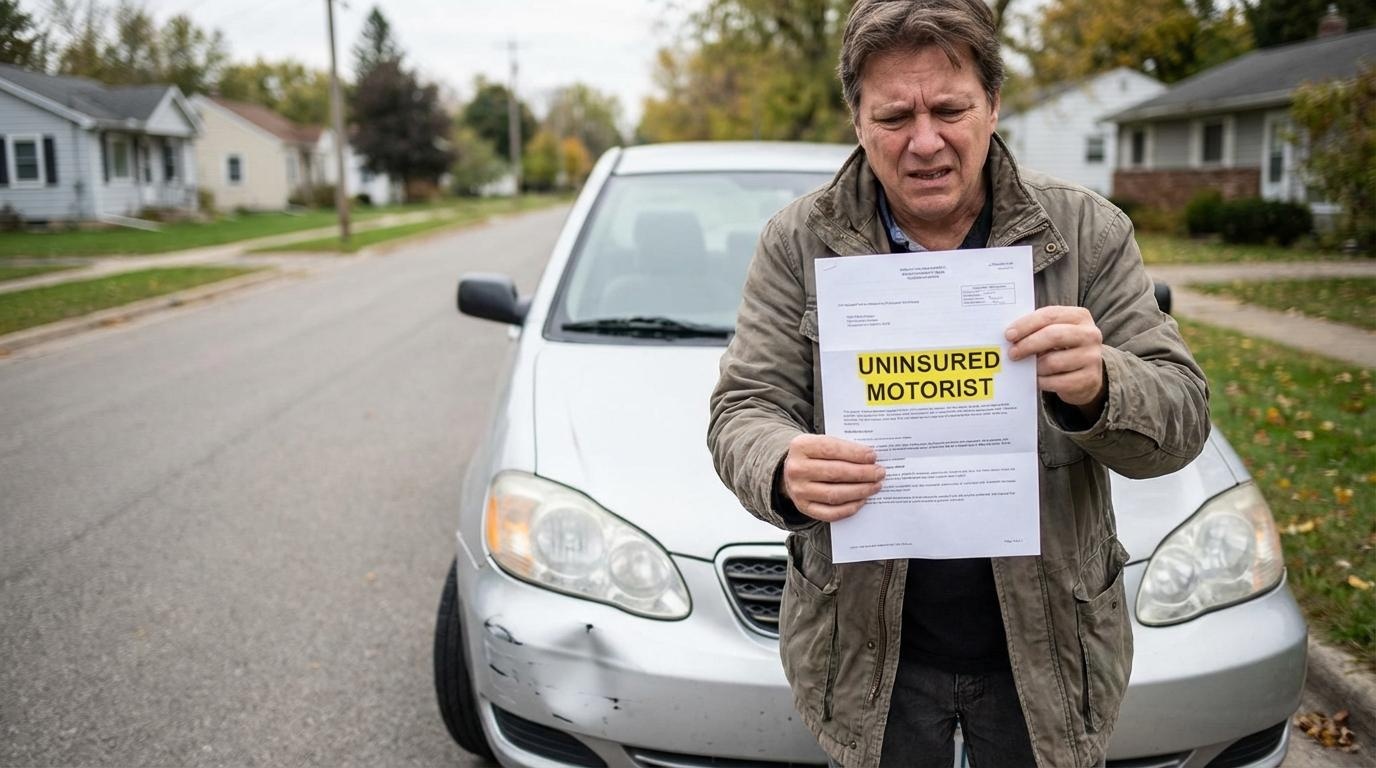
You are driving home from work, obeying the speed limit, and approaching an intersection with a green light. Suddenly, a vehicle runs the red light and T-bones your car. The impact totals your vehicle and leaves you with a broken collarbone, a concussion, and an immediate need for an ambulance. The police arrive, secure the scene, and ask the at-fault driver for their insurance information. The driver hands the officer an expired card, looks at the ground, and admits the truth: they don't have auto insurance.
In that agonizing moment, the physical trauma of the accident is immediately eclipsed by a terrifying financial reality. You did everything right. You managed your driving record, you paid your premiums, and you bought a safe car. But because the person who hit you broke the law, you are now facing $40,000 in medical bills and the loss of a $30,000 vehicle. Who is going to pay for this?
If you sue the at-fault driver, you will likely win a massive judgment in court. But as the legal adage goes, "You can't get blood from a stone." A driver who cannot afford a $100-a-month liability policy almost certainly does not have $70,000 in liquid assets to seize. They are "judgment proof."
This scenario is not a rare nightmare; it is a statistical probability. In the high-inflation economy of 2026, auto insurance premiums have surged, driven by technological repair costs and social inflation. In response, a staggering number of Americans have simply stopped paying for coverage. The Insurance Research Council estimates that, nationally, one in eight drivers (about 12-14%) is completely uninsured. In certain high-risk states, that number approaches 25%. You are sharing the road with millions of financial time bombs.
Your only true defense against this crisis is a specialized section of your own auto policy known as Uninsured and Underinsured Motorist Coverage (UM/UIM). This exhaustive masterclass will demystify this critical protection. We will dissect the technical difference between Bodily Injury and Property Damage UM, explain the powerful strategy of "Stacking" limits, and prove why relying on your health insurance is a catastrophic mistake.
Part 1: The Mechanics of the Shield—What is UM/UIM?
To understand UM/UIM, you must first understand standard liability. As we detailed in our ultimate guide to liability insurance, your Bodily Injury (BI) and Property Damage (PD) liability limits pay for the damage you cause to others.
Uninsured Motorist coverage flips that equation. It is liability insurance that you buy for the other guy, to pay yourself.
When an uninsured driver hits you, your insurance company steps into the shoes of the at-fault driver. Your insurer acts as if they insured the person who hit you, and they write the check to cover your damages, up to the limits you selected for your UM/UIM coverage.
This coverage is typically broken down into four distinct pillars, and depending on your state, you must select and pay for them individually.
Pillar 1: Uninsured Motorist Bodily Injury (UMBI)
This is the most vital component. If you are hit by a driver with zero insurance, or by a "hit-and-run" driver who flees the scene (often called a "phantom vehicle"), UMBI pays for your physical recovery.
- What it covers: Ambulance rides, emergency room visits, surgeries, physical therapy, and—crucially—lost wages if you cannot work. It also pays "general damages" for pain and suffering, which your health insurance will never pay.
- Who it covers: It covers you (the named insured), any family members residing in your household, and any passengers riding in your insured vehicle at the time of the crash. Amazingly, UMBI often covers you even if you are not in your car; if you are hit by an uninsured driver while riding a bicycle or walking across a crosswalk, your auto policy's UMBI will respond.
Pillar 2: Underinsured Motorist Bodily Injury (UIMBI)
This addresses a much more insidious threat: the legally insured, but financially inadequate driver. Every state mandates a minimum amount of liability insurance. In places like California or Pennsylvania, that minimum can be as low as $15,000 or $25,000 per person.
- The Trap: You are hit by a driver carrying the state minimum of $25,000. You suffer a severe spinal injury requiring $100,000 in surgery. The at-fault driver's insurance pays out their maximum $25,000 limit and walks away. You are left $75,000 in debt.
- The Solution: If you carry $100,000 in UIMBI coverage, your policy kicks in after the at-fault driver's policy is exhausted. Your insurer pays the remaining $75,000 difference, making you whole.
Pillar 3: Uninsured Motorist Property Damage (UMPD)
While UMBI covers your body, UMPD covers your machine. If an uninsured driver totals your car, UMPD pays to repair or replace your vehicle (up to its Actual Cash Value).
- The Collision Overlap: Many drivers ask, "If I have Collision coverage, do I need UMPD?" Both cover damage to your car. However, Collision coverage requires you to pay a deductible (often $500 or $1,000), and filing a Collision claim can result in a rate surcharge because your company pays regardless of fault.
- The UMPD Advantage: In many states, UMPD has a much lower deductible (often $250) or no deductible at all. More importantly, using UMPD definitively proves you were not at fault, which often protects your "claims-free" discount at renewal. (Note: Some states do not offer UMPD, forcing you to rely on Collision).
Pillar 4: Underinsured Motorist Property Damage (UIMPD)
Similar to UIMBI, this covers the gap when the at-fault driver has property damage limits that are too low to replace your car. If they carry a $10,000 property damage limit, but they total your $60,000 electric vehicle, UIMPD pays the $50,000 difference.
Part 2: The "Health Insurance" Fallacy
When reviewing their policies during an annual insurance audit, many consumers attempt to decline UMBI coverage to save a few dollars. Their logic is seemingly sound: "Why should I pay for Uninsured Motorist medical coverage when I already have excellent health insurance through my employer?"
This is a dangerous, multi-tiered fallacy that leaves families vulnerable to bankruptcy. Here is why health insurance is not a substitute for UMBI:
- Deductibles and Co-Pays: Health insurance is not free at the point of service. If you are hospitalized, you must still meet your annual health deductible (which can be $5,000 or more on a high-deductible plan) and pay 20% coinsurance on surgeries. UMBI pays from dollar one.
- Lost Wages: Health insurance pays doctors; it does not pay your mortgage. If a broken leg prevents you from working for two months, health insurance offers zero income replacement. UMBI explicitly covers lost wages resulting from the accident.
- Pain and Suffering: If an accident leaves you with a permanent limp or severe PTSD, health insurance provides zero compensation for your diminished quality of life. UMBI pays out general damages for pain and suffering, just as if you had successfully sued the at-fault driver.
- The Subrogation Trap: If your health insurer pays $50,000 for your accident-related surgeries, and you later manage to squeeze a small $10,000 settlement out of the at-fault driver, your health insurance company has a legal right (called "subrogation") to take that $10,000 to reimburse themselves. UMBI protects your settlement money.
Part 3: The Mathematical Strategy—Matching Your Limits
How much UM/UIM coverage do you actually need? The golden rule of auto insurance architecture in 2026 is Symmetry.
Your Uninsured Motorist limits should exactly mirror your Bodily Injury Liability limits. If you have followed our professional advice to protect your assets, you likely carry liability limits of 100/300/100 ($100,000 per person / $300,000 per accident for bodily injury).
- The Mismatch Error: Some agents will quote a policy with 100/300 liability (protecting others) but drop the UM/UIM limits down to the state minimum (e.g., 25/50) to make the overall premium look cheaper.
- The Injustice: This means you are willing to pay your insurance company up to $100,000 to fix a stranger's broken arm if you cause an accident, but you are only willing to pay yourself $25,000 if a stranger breaks your arm. You must value your own family's physical and financial health as highly as you value a stranger's. Always demand matching limits.
If you have a high net worth and carry a Personal Umbrella Policy for $1 Million or more, you must ensure that your umbrella policy also includes an Uninsured Motorist Umbrella Endorsement. Standard umbrellas only provide liability (paying others); you must explicitly buy the endorsement to stack that $1 Million limit on top of your auto policy's UM/UIM limits to protect yourself against a catastrophic, life-altering injury caused by a broke driver.
Part 4: The Power of "Stacking" (The Secret Multiplier)
If you live in a state that permits it (roughly half of U.S. states, including Florida, Pennsylvania, and Texas), you have access to a powerful multiplier known as "Stacked" UM/UIM coverage.
Stacking allows you to combine the UM/UIM limits of multiple vehicles on your policy to increase your total available payout for a single accident.
The Math of Stacking
Imagine you are a married couple with two cars insured on the same policy. You select UMBI limits of $100,000 per person / $300,000 per accident.
- Unstacked (Non-Stacked): If you are hit by an uninsured driver, the absolute maximum your policy will pay for your injuries is $100,000, regardless of how many cars you own.
- Stacked: Because you pay a premium for two cars, you are allowed to add the limits together. 2 cars x $100,000 = $200,000 per person. If you own three cars, your limit jumps to $300,000.
Why Stacking is Essential in 2026
In 2026, a multi-day stay in an ICU followed by orthopedic surgery can easily exceed $150,000. If you have "Unstacked" limits of $100k, you are $50,000 short. Stacking effectively doubles or triples your safety net for a nominal premium increase (usually 5% to 10% more than unstacked coverage).
The Audit Action: During your annual review with your independent broker, specifically ask: "Is my Uninsured Motorist coverage Stacked or Non-Stacked?" If your state allows it, you should always choose the Stacked option. It is the cheapest way to buy a massive amount of high-tier medical protection.
Part 5: The "Hit and Run" Nightmare and the Police Report
Uninsured Motorist coverage is your only recourse in a hit-and-run accident, which is a growing epidemic in major metropolitan areas. If a driver hits you and speeds away, they are treated by the insurance company as an "Uninsured Motorist" (the "phantom vehicle").
However, insurance companies are highly skeptical of hit-and-run claims, as drivers sometimes falsely claim a "phantom vehicle" ran them off the road to cover up their own single-car accident (e.g., falling asleep and hitting a tree) to avoid an at-fault surcharge.
The Golden Rule of a Hit and Run
To successfully claim UM/UIM benefits for a hit and run, you must follow a strict, unyielding protocol:
- The Police Report: You MUST file a police report within 24 hours of the incident. In many states, this is a legal requirement written into the insurance contract. If you wait a week to report it to the police, the insurer will deny the UM claim outright.
- The Physical Evidence: While some states allow "miss-and-run" claims (where the phantom car ran you off the road without touching you), many strict states require physical proof that another car struck yours (paint transfer, specific dent patterns).
- Independent Witnesses: Gather names and phone numbers of anyone who saw the fleeing vehicle. Their testimony is the difference between a paid UM claim and an at-fault collision denial.
Conclusion: Defensive Driving Extends to Your Wallet
Driving defensively means anticipating the mistakes of others on the physical road. Purchasing robust Uninsured and Underinsured Motorist coverage means anticipating the mistakes of others in their financial lives.
You cannot control the fact that one out of every eight drivers passing you on the highway has made the reckless, illegal decision to drive without a financial safety net. You cannot control the fact that state minimum liability limits are pathetically inadequate to cover the cost of modern medical care.
What you can control is your own policy. In 2026, your auto insurance is not just a shield against lawsuits; it is a critical pillar of your own healthcare and income protection strategy. Do not view UM/UIM as an optional "add-on" to be discarded to save ten dollars a month. It is the core of your defense.
Audit your policy today. Demand that your UM/UIM limits match your bodily injury limits. Choose "Stacked" coverage if your state allows it. And ensure your umbrella policy is equipped to handle the worst-case scenario. The roads are unpredictable, but your financial recovery shouldn't be. Drive safe, stay alert, and ensure you are covered when the other guy isn't.
Share this article
About the Author
Josef Bako
Auto Safety & Risk Consultant
Josef is a former automotive safety engineer who transitioned into insurance risk assessment. He specializes in helping families navigate the high costs of insuring teen drivers and understanding vehicle safety ratings.
Related Articles

Usage-Based Car Insurance Apps: Are They Really Worth It in 2026?
Car insurance apps promise massive discounts if you let them track your driving. But how accurate are they at detecting hard braking or phone use? We analyze the data, privacy risks, and real-world savings in 2026 to see if UBI apps are worth it.
Josef Bako
The Named Driver Exclusion: Saving Your Auto Insurance Rate
Is a high-risk roommate or a teenager with a DUI ruining your car insurance rate? Learn how the "Named Driver Exclusion" can instantly lower your premium—and the catastrophic risks of using it incorrectly.
Marcus Seneki