The Ultimate HO-6 Dwelling Coverage Calculator: How to Insure Your Condo Interior
Adams Kotel
Published on
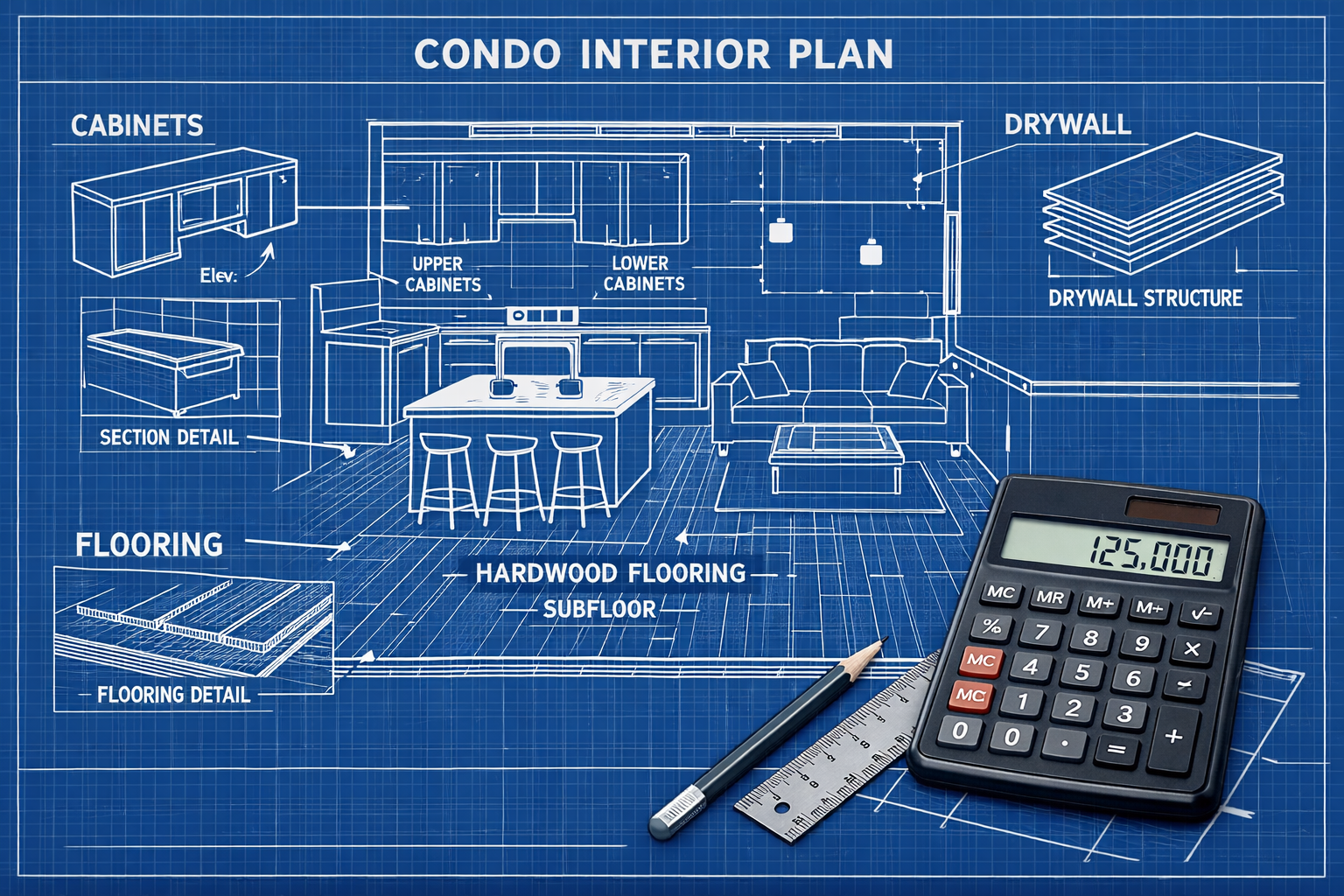
When you purchase a condominium, you are buying into a unique, shared-ownership structure that requires a highly specialized type of insurance. As we detailed in our foundational guide to condo insurance (HO-6), the building’s exterior and common areas are protected by the Homeowners Association's (HOA) Master Policy. Your personal responsibility is to protect the interior of your specific unit. This protection is provided by Coverage A: Dwelling within your personal HO-6 policy.
However, determining exactly how much Coverage A you need is one of the most frustrating and misunderstood aspects of condo ownership. If you buy a single-family house, your agent simply runs a software program to estimate the cost to rebuild the entire structure from the ground up. But in a condo, you are only rebuilding a portion of the structure.
Search data from Bing in 2026 reveals a massive volume of highly specific queries: "ho6 dwelling coverage calculator," "diagram of ho6 coverage," and "are ho6 cabinets covered?" These searches expose a critical knowledge gap. Many condo owners are either drastically underinsured, leaving themselves exposed to a $50,000 bill after a kitchen fire, or they are vastly over-insured, wasting hundreds of dollars a year in unnecessary premiums.
This exhaustive masterclass is the solution. We will provide a conceptual diagram of HO-6 coverage boundaries, definitively answer the "cabinet" question, and provide a step-by-step mathematical calculator to determine your exact Coverage A limit based on your HOA's specific Master Policy.
Part 1: The "Diagram of HO-6 Coverage"—Where Does the Master Policy Stop?
To calculate your coverage, you must first draw a mental diagram of your condo unit. Imagine standing in the center of your living room. Everything you see around you is governed by a strict legal border between the HOA and you.
As we explored in our guide to condo claims, the exact location of this border is dictated by the HOA's Master Policy, which comes in three distinct variations.
1. The "All-In" (All-Inclusive) Master Policy
- The Diagram: Imagine a bubble that covers the entire building exterior, the framing, the drywall, the flooring, the plumbing fixtures, and all the cabinets. The HOA insures the unit exactly as it stands today, including any custom upgrades you or previous owners installed.
- Your Coverage A Need: Extremely low. Because the HOA is rebuilding the interior structure, your HO-6 Dwelling coverage only needs to act as a "buffer" for gaps or minor alterations.
2. The "Single Entity" (Original Spec) Master Policy
- The Diagram: Imagine the bubble covers the exterior, the framing, the drywall, and the original builder-grade fixtures. If the developer built the condo in 2005 with cheap laminate countertops and basic carpet, the HOA will only pay to replace those original materials.
- Your Coverage A Need: Moderate. You must insure the value of any upgrades made since the original construction. If you ripped out the carpet and put in $15,000 hardwood floors, your HO-6 Coverage A must be at least $15,000.
3. The "Bare Walls-In" Master Policy (The Danger Zone)
- The Diagram: Imagine the HOA’s bubble stops at the raw, unpainted wooden studs and the concrete subfloor. Nothing else is covered.
- Your Coverage A Need: Extremely high. If the building burns down, the HOA will build the wooden box. You are financially responsible for the drywall, the insulation, the paint, the flooring, the plumbing fixtures, the electrical outlets, and yes, the cabinets.
Part 2: "Are HO-6 Cabinets Covered?" The Definitive Answer
This is one of the most frequently asked questions by condo owners. Kitchen cabinets are astronomically expensive, often representing the largest single line item in an interior rebuild.
The Answer: Yes, cabinets are covered, but whose policy covers them depends entirely on the Master Policy.
- In an "All-In" HOA: The HOA’s Master Policy covers the cabinets.
- In a "Single Entity" HOA: The Master Policy covers the original cabinets. If you upgraded to custom cherry wood cabinets, your HO-6 Coverage A pays the difference.
- In a "Bare Walls" HOA: Your HO-6 Coverage A is 100% responsible for the cabinets. If your Coverage A limit is too low, you will be buying your new kitchen out of pocket.
Important Note: Cabinets are permanently attached to the walls. Therefore, they are always classified as "Dwelling" (Coverage A) or "Building Alterations," never as Personal Property (Coverage C). Your Coverage C limit is for things you can pick up and walk out the door with, like a sofa or a television.
Part 3: The HO-6 Dwelling Coverage Calculator
Do not guess your Coverage A limit. Use this professional, step-by-step calculation framework to arrive at the correct number for 2026.
Step 1: Obtain the Master Policy Declarations
You cannot proceed without knowing your starting point. Email your HOA property manager today and request the "CC&Rs" (Covenants, Conditions, and Restrictions) and the current Master Insurance Policy Declarations page. Look for the definition of the "Unit Boundaries."
Step 2: The "All-In" Calculation
If your HOA has an All-In policy, your math is simple.
- The Base: Most independent brokers recommend a minimum "buffer" limit of $10,000 to $25,000 in Coverage A.
- Why? Even if the HOA covers the interior, there are often disputes over high-end fixtures. A small buffer ensures you have cash available to fix minor damages without fighting the HOA board. Furthermore, some HO-6 policies tie your Loss of Use (Coverage D) limit to a percentage of Coverage A.
Step 3: The "Single Entity" (Upgrades) Calculation
If the HOA covers only the "original specifications," you must calculate the cost of your upgrades.
- Flooring: Did you upgrade from carpet to hardwood/tile? Estimate the cost to replace the upgraded flooring in 2026 dollars. (e.g., 1,000 sq ft x $12/sq ft = $12,000).
- Kitchen/Bath: Did you upgrade from laminate to quartz/granite? Did you install custom tile showers or premium cabinets? (e.g., $20,000).
- Built-ins: Did you add permanent bookshelves or a custom closet system? (e.g., $5,000).
- The Formula: (Cost of Upgraded Materials) - (Value of Original Builder Materials) = Your Coverage A Need.
- The Safety Buffer: Always add an extra 20% for construction inflation.
- Example Total: $12k + $20k + $5k = $37,000 + 20% = $44,400 Coverage A Limit.
Step 4: The "Bare Walls-In" Calculation (The Full Interior Rebuild)
If your HOA is "Bare Walls," you must calculate the cost to rebuild the entire interior from the studs out. This is essentially a massive remodeling project. In 2026, the average cost to rebuild a mid-range condo interior (drywall, paint, standard floors, standard kitchen/bath) ranges from $75 to $150 per square foot, depending on your local labor market. High-end luxury condos in major coastal cities can exceed $250+ per square foot.
The "Bare Walls" Math Formula:
- Determine Square Footage: Let’s assume a 1,200 sq ft condo.
- Determine Finish Quality: Let's assume a "Standard" finish quality at $125/sq ft.
- The Calculation: 1,200 sq ft x $125 = $150,000.
- Add Ordinance or Law: As we detailed in our guide to code upgrades, you must add 10% to 25% to cover the cost of bringing new electrical or plumbing up to 2026 codes during a rebuild. ($150,000 x 10% = $15,000).
- Final Bare Walls Coverage A Limit: $165,000.
Part 4: The Ultimate Danger—The Master Policy Deductible
There is a final, critical variable that overrides all the math above. You must look at the Deductible on the HOA’s Master Policy.
Due to rising insurance costs in 2026, many HOAs are raising their Master Policy deductibles to astronomical levels to save money—often $25,000, $50,000, or even $100,000 per building.
- The Master Deductible Trap: If a fire starts in your kitchen and destroys the building, the HOA will file a claim. However, many HOA bylaws state that the unit owner where the damage originated is responsible for paying the HOA's deductible. If the HOA deductible is $50,000, you will be handed a bill for $50,000 before the Master Policy pays a single dollar.
The Solution: You must ensure your HO-6 policy includes a specific endorsement called Loss Assessment Coverage. If you are hit with a $50,000 assessment to cover the Master Deductible, your Loss Assessment coverage will pay it. Do not rely on the standard $1,000 limit. You must increase your Loss Assessment limit to equal or exceed the HOA's Master Deductible. The cost to increase this limit is usually less than $30 a year, making it the most vital "hidden" coverage in the condo market.
Part 5: The "Primary vs. Excess" Clause
When a claim occurs, and there is overlap between your Coverage A and the Master Policy (which often happens in "Single Entity" structures), disputes arise over who pays first.
Most modern HOA bylaws contain a "Primary/Excess" clause. This clause dictates that the HOA Master Policy is "Primary." This means the HOA must pay its limits first, and your personal HO-6 policy acts as "Excess," stepping in only when the HOA policy is exhausted or to cover the HOA's deductible.
However, some older HOAs have bylaws that state the Unit Owner's policy is primary. If you live in one of these complexes, your Coverage A limit must be much higher, as your insurance company will bear the brunt of the initial payout. This is why having an independent broker review your HOA documents before writing the policy is a massive strategic advantage.
Part 6: The "Improvements and Betterments" Endorsement
If you have calculated your Coverage A need based on Step 3 (The Upgrades), you must ensure your policy specifically covers "Improvements and Betterments."
In some basic HO-6 policies, Coverage A is strictly limited to the bare walls, and you must purchase a separate "Additions and Alterations" endorsement to cover the custom cabinets or hardwood floors. Review your declarations page carefully. If you see Coverage A listed at $10,000 and no mention of "Alterations," you are likely underinsured for the upgrades you've made to the unit.
Part 7: What About Your Stuff? (Coverage C)
While this guide focuses on the "Dwelling" (Coverage A), we must briefly address the other half of the equation. Your furniture, electronics, clothing, and rugs are covered under Coverage C (Personal Property).
- The Inventory Method: The only way to calculate this number accurately is to perform a detailed home inventory. Go room by room and estimate the cost to buy everything brand new.
- The RCV Imperative: You must ensure your Coverage C includes Replacement Cost Value (RCV), not Actual Cash Value (ACV). As we explained in our ACV vs. RCV masterclass, an ACV policy will only pay you "garage sale" prices for your 5-year-old sofa. RCV guarantees you receive enough money to buy a brand-new sofa at current retail prices.
- The High-Value Exceptions: Remember that Coverage C has strict sub-limits (often $1,500) for stolen jewelry, watches, or firearms. If you own high-value items, you must use a Scheduled Personal Property endorsement to fully protect them.
Conclusion: Engineering Your Financial Shield
Insuring a condominium is a complex engineering problem. You are building a financial bridge between where the HOA's responsibility ends and where your personal liability begins. Relying on a "rule of thumb" or a generic online quote to set your HO-6 Coverage A limit is a gamble that routinely results in tens of thousands of dollars in uncovered losses.
In 2026, the cost of interior reconstruction and custom cabinetry is too high to leave to chance. By demanding your HOA documents, understanding the "Bare Walls" vs. "All-In" diagram, and methodically calculating your interior replacement cost, you take control of your financial destiny.
Do not wait for a burst pipe or a kitchen fire to test your math. Perform a comprehensive insurance audit today. Call your agent, review the Master Policy deductible, maximize your Loss Assessment coverage, and ensure that your condo remains a sanctuary of equity, not a liability trap. Drive safe, calculate accurately, and stay covered.
Share this article
About the Author
Adams Kotel
Lead Insurance Analyst
Adams has over 15 years of experience in the insurance industry, specializing in personal line products. He is passionate about demystifying complex insurance topics and helping consumers make educated decisions.
Related Articles

How Much HO-6 Dwelling Coverage is Needed for a 2,053 Square Ft Condo? (A Mathematical Case Study)
Calculating condo insurance isn't a guessing game. We break down the exact math for a 2,053 sq ft luxury condo, explaining "Coverage A," local construction costs, and the dangers of underinsuring a high-end unit.
Adams Kotel

The HO-6 Policy Training Outline: A Masterclass for New Condo Owners
An structured, step-by-step training outline designed to take you from a condo insurance novice to an HO-6 expert. Learn to decode master policies, calculate coverage, and protect your equity.
Adams Kotel