The Ultimate Guide to Checking and Disputing Your C.L.U.E. Report
Adams Kotel
Published on
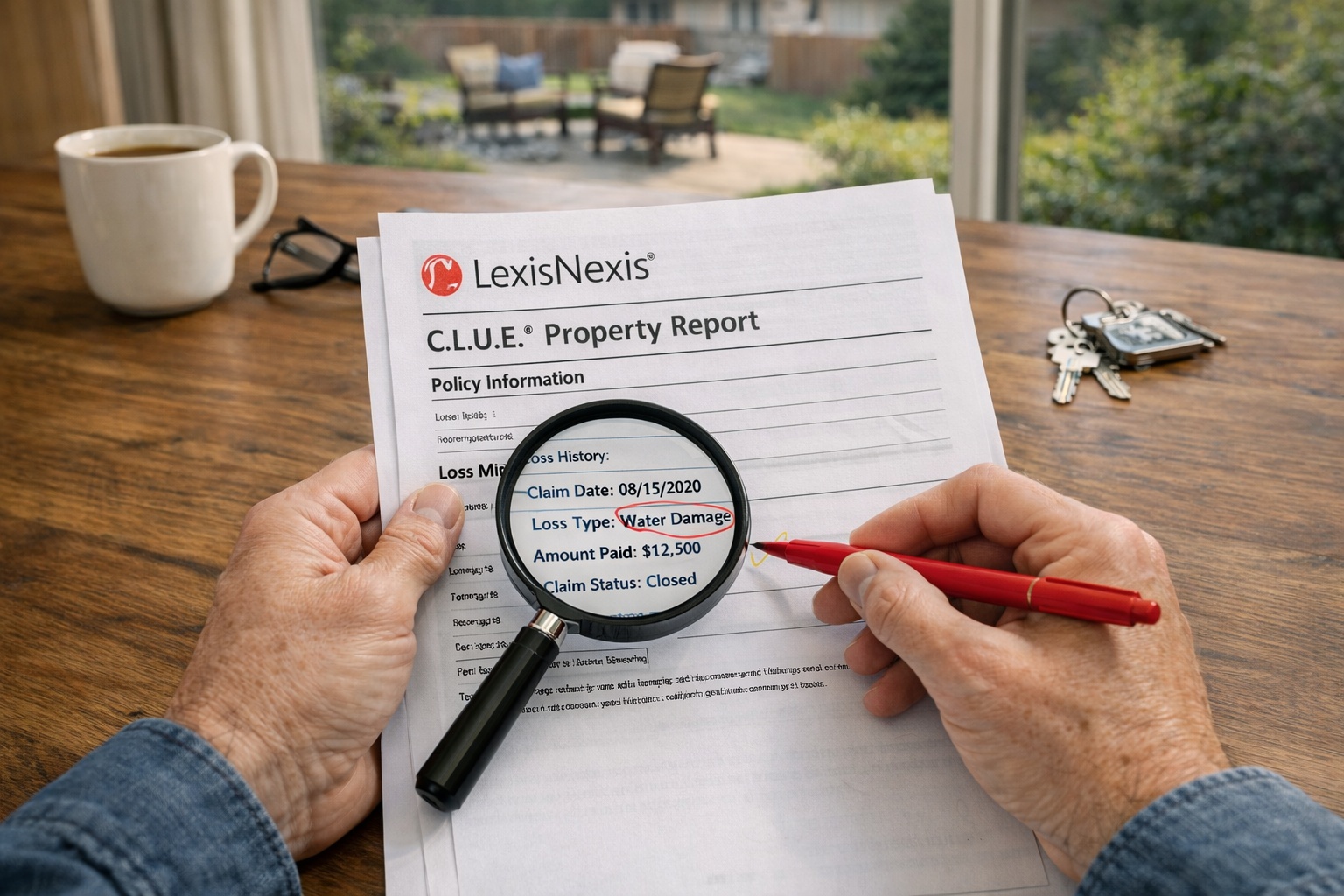
You have spent weeks diligently preparing to buy a new home. You secured a phenomenal mortgage rate, the appraisal came back flawless, and the home inspection passed with flying colors. The finish line is in sight. Your lender asks you to secure a standard homeowners insurance policy so they can finalize the closing documents. You confidently call your independent insurance broker, expecting a routine conversation and a reasonable premium quote. Instead, the broker returns with devastating news: not only are the quotes astronomically high, but several major carriers have flatly refused to insure the property at all.
You are stunned. You have excellent credit—which we know from our analysis of credit-based insurance scores is a major factor—and you have never filed a homeowners claim in your life. When you demand an explanation, the broker mentions a database you have likely never heard of: the C.L.U.E. report. It turns out, the previous owner of the house filed two massive water damage claims in the last three years. Even though you had nothing to do with those claims, the house is now blacklisted, and you are left to pay the price.
Or perhaps the scenario is even more insidious: you are simply trying to renew your auto insurance, and the premium has spiked by 40%. You discover that a minor fender-bender where you were completely cleared of fault—and where your insurance company paid absolutely nothing—is listed on your record as an "at-fault collision."
Welcome to the hidden, high-stakes world of the Comprehensive Loss Underwriting Exchange (C.L.U.E.). In the 2026 insurance market, your C.L.U.E. report is the ultimate arbiter of your insurability. It is a massive, centralized database managed by the data brokerage giant LexisNexis, and it dictates the financial reality of nearly every property and casualty insurance transaction in the United States.
Search queries like "false claim on insurance history" and "how to check my insurance record" are surging as consumers awaken to the power of this invisible ledger. This exhaustive, 2,200-word masterclass will serve as your definitive guide to understanding, accessing, and correcting your C.L.U.E. report. We will expose the "Zero-Payout Trap," detail your federal rights under the Fair Credit Reporting Act, and provide a step-by-step, legal protocol for disputing the errors that are silently draining your bank account.
Part 1: What Exactly is the C.L.U.E. Report?
To defeat an enemy, you must first understand it. C.L.U.E. stands for the Comprehensive Loss Underwriting Exchange. It is a claims history database created and maintained by LexisNexis Risk Solutions. Over 99% of all auto and homeowners insurance companies writing policies in the United States contribute data to this system and pull data from it every single day.
When you apply for a new insurance policy, or when your current policy comes up for renewal, the underwriter's computer system automatically pings the LexisNexis database.
The Two Types of Reports
There are actually two distinct C.L.U.E. databases:
- C.L.U.E. Auto: This tracks your personal history of automobile claims. It follows you, the driver, regardless of what car you were driving.
- C.L.U.E. Property: This tracks the history of a specific physical address. It follows the house, regardless of who owned it at the time of the claim.
The Seven-Year Sentence
The most critical feature of the C.L.U.E. report is its memory. Under the rules established by LexisNexis and federal regulations, a claim remains visible on your C.L.U.E. report for seven years from the date the claim was filed. (Some states restrict insurers from using data older than three or five years to set rates, but the data itself remains on the report for the full seven).
This means a momentary lapse of judgment in 2019, or a hailstorm that hit your roof in 2021, is actively dictating the premiums you are paying in 2026.
What Data is Actually Stored?
The report is meticulously detailed. For every incident, the database records:
- Your name, date of birth, and Social Security Number.
- The date of the loss.
- The type of loss (e.g., Wind, Water, Fire, Collision, Comprehensive).
- The status of the claim (Open, Closed, Subrogated).
- The Amount Paid: The exact dollar figure the insurance company paid out.
Part 2: The "Zero-Payout" Trap (The Most Dangerous Error)
One of the most infuriating and misunderstood aspects of the C.L.U.E. reporting system is the "Zero-Payout" or "Inquiry" trap. This is a scenario we frequently warn our readers about when discussing the hidden math of filing a water damage claim.
The Scenario
You discover a few missing shingles on your roof after a storm. You aren't sure if the damage exceeds your $2,500 deductible, so you call your insurance company's 1-800 claims hotline simply to "ask a question" or "get an adjuster's opinion." The adjuster comes out, tells you the repair will only cost $800, and leaves. You pay a local roofer $800 out of your own pocket. The insurance company pays absolutely nothing ($0). You assume you have avoided a claim on your record.
The Reality
You are wrong. Because you called the claims hotline, the insurance company opened a formal "Claim File." Even though they closed it without paying a dime, they are legally obligated to report that interaction to LexisNexis.
It will appear on your C.L.U.E. report as:
- Date: 04/15/2025 | Type: Wind/Hail | Status: Closed | Amount Paid: $0
Why Underwriters Hate Zero-Payout Claims
You might think an underwriter wouldn't care about a claim that cost the company nothing. However, actuarial science dictates otherwise. Underwriters view a zero-payout claim as an indicator of a "claims-conscious" consumer—someone who is highly likely to file a massive claim the moment the damage does exceed their deductible.
Furthermore, if the zero-payout claim was for water damage (e.g., a small leak you fixed yourself), the underwriter assumes there is hidden mold or systemic plumbing issues that you are hiding. They will aggressively raise your rates or deny your application based on an incident where they suffered no financial loss.
Part 3: The "Inherited Risk" of Buying a Home
If you are buying a home, the C.L.U.E. Property report is just as important as the physical home inspection.
When an insurance company quotes a policy for a new home purchase, they pull the address's C.L.U.E. report. If the previous owner filed two massive water claims and a dog bite liability claim, the house is statistically flagged as a "High-Risk Property."
- The Consequence: The insurance company may refuse to write a policy for you, completely derailing your mortgage closing. If they do write it, they may charge triple the normal premium, or they may attach an endorsement excluding all future water damage, leaving you exposed to the expensive pipe problems we have analyzed previously.
- The Buyer's Dilemma: Under federal privacy laws, you cannot pull a C.L.U.E. report for a home you do not yet own. Only the current owner can request it.
- The Strategic Move: If you are under contract to buy a home, you must add a contingency requiring the seller to provide a copy of the home's C.L.U.E. report within five days. If the report shows a history of severe claims, you must either renegotiate the price to account for the inflated insurance premiums or walk away from the deal entirely.
Part 4: Your Federal Rights Under the FCRA
Because the C.L.U.E. report dictates your financial standing, it is regulated by the federal government under the Fair Credit Reporting Act (FCRA) and the FACT Act (Fair and Accurate Credit Transactions Act).
LexisNexis is legally classified as a "Consumer Reporting Agency," exactly like Equifax, Experian, and TransUnion. This classification grants you three immutable rights:
- The Right to Access: You are legally entitled to request one free copy of your C.L.U.E. Auto and C.L.U.E. Property report every 12 months.
- The Right to Know: If an insurance company raises your rates, denies your application, or cancels your policy based on information in your C.L.U.E. report, they must send you an "Adverse Action Notice." This letter must explicitly state that LexisNexis data was used and provide you with instructions on how to get a free copy of the report.
- The Right to Dispute: If the information on your report is inaccurate, incomplete, or outdated, you have the legal right to dispute it. LexisNexis is legally required to investigate your dispute, usually within 30 days, and correct or delete the erroneous data.
Part 5: How to Request Your Free C.L.U.E. Report
You should not wait for an "Adverse Action Notice" to pull your report. Just as you should perform an annual insurance audit of your coverages, you should perform an annual audit of your C.L.U.E. data.
The Process:
- Online: Navigate to the official LexisNexis Risk Solutions consumer portal (consumer.risk.lexisnexis.com).
- By Mail or Phone: You can request the report via standard mail by filling out their specific request form, or by calling their toll-free consumer disclosure line.
- Identity Verification: Because this is highly sensitive financial data, you will be required to answer security questions based on your public record history to prove your identity.
When the report arrives (usually via a secure digital download), it may be blank. A blank C.L.U.E. report is the ultimate goal. It means you have zero claims history in the last seven years, making you a "Preferred Risk" to any underwriter.
Part 6: How to Audit Your Report for Errors
When you review your report, you must act as a forensic accountant. Look for these four common errors that are artificially inflating your premiums:
- The "Not Me" Error: Ensure that claims filed by someone with a similar name, or claims filed by an ex-spouse after your divorce was finalized, are not appearing on your personal file.
- The "Duplicate" Claim: Sometimes a single incident (e.g., a car accident that damaged the bumper and the windshield) is accidentally entered by the adjuster as two separate claims on the same date. Two claims are mathematically far worse for your rates than one large claim.
- The "At-Fault" Error: If you were rear-ended and the police report cleared you of fault, your report should reflect that. If your insurer paid out under your Uninsured Motorist (UM) coverage because the other driver fled, ensure the claim is coded correctly as "Not At-Fault."
- The "Ghost" Payout: If you called to ask a question and paid for the repair yourself (the Zero-Payout scenario), ensure the report specifically says "$0 Paid." If it shows a phantom payout amount, the insurer made a massive clerical error that is costing you money.
Part 7: The Dispute Protocol—How to Force a Correction
If you find an error, you must initiate a formal dispute. Do not call your insurance agent; they cannot change the LexisNexis database. You must go directly to the source.
Step 1: Gather Your Irrefutable Evidence LexisNexis will contact the insurance company that reported the data and ask them to verify it. To win, you must provide documentation that proves the insurance company's data is wrong.
- For Auto Claims: Obtain the official police report proving you were not at fault, or a "Letter of Experience" from your previous carrier detailing the specific nature of the payout.
- For Home Claims: If a zero-payout claim was entered, provide the paid invoice from the private contractor proving you handled the repair without insurance funds.
Step 2: File the Formal Dispute You can file the dispute online through the LexisNexis portal or via certified mail. Be concise and authoritative.
- The Script: "I am exercising my rights under the FCRA to dispute inaccurate information on my C.L.U.E. Property report. Claim #[Number] dated [Date] is listed as an at-fault water loss with a $5,000 payout. This is factually incorrect. No funds were ever disbursed by the carrier, and the claim was withdrawn. I have attached the formal denial letter from the carrier and the invoice showing I paid the plumber out-of-pocket. I demand this claim be removed or corrected to reflect $0 paid within the mandated 30-day window."
Step 3: The "Consumer Statement" Fallback If LexisNexis investigates and the insurance company stubbornly (and wrongly) insists their data is correct, LexisNexis will leave the item on your report. However, under the FCRA, you have the right to add a "Consumer Statement" (up to 100 words) directly to your file.
- The Tactic: Add a statement explaining the truth. When a future underwriter pulls your report, they must legally read your statement. Often, a reasonable underwriter will see your logical explanation (e.g., "This was an inquiry only, no damage occurred") and manually override the algorithmic penalty.
Part 8: The A-PLUS Alternative Database
While LexisNexis holds a near-monopoly with C.L.U.E., there is a secondary database you should be aware of: the A-PLUS (Automated Property Loss Underwriting System), managed by Verisk Analytics.
A smaller percentage of insurers use A-PLUS instead of, or in addition to, C.L.U.E. If you have audited your C.L.U.E. report and it is clean, but you are still being denied coverage for "claims history," you must immediately request your free A-PLUS report from Verisk. The dispute process and your federal rights under the FCRA apply identically to the A-PLUS system.
Conclusion: Reclaiming Your Data
In 2026, you are not just a driver or a homeowner; you are a data set. The insurance industry has optimized its profitability by relying on vast, centralized databases to make automated, split-second decisions about your financial future. While this system is highly efficient for the corporations, it is profoundly unforgiving to the consumer. A single clerical error by an exhausted claims adjuster can echo through your finances for seven years, costing you thousands of dollars in unjustified premiums.
You cannot afford to be passive. You must treat your C.L.U.E. report with the same vigilance and protective anxiety that you apply to your FICO credit score.
By understanding the absolute power of the LexisNexis database, aggressively dodging the "Zero-Payout" inquiry trap, and exercising your federal rights to audit and dispute your records, you reclaim control over your digital identity. At Surety Insights, we believe that Knowledge is the Only Unsinkable Shield. Do not let a ghost claim drain your wealth. Pull your report today, challenge the errors, and force the insurance market to rate you on the truth, not a typo. Drive safe, document everything, and stay covered.
Share this article
About the Author
Adams Kotel
Lead Insurance Analyst
Adams has over 15 years of experience in the insurance industry, specializing in personal line products. He is passionate about demystifying complex insurance topics and helping consumers make educated decisions.
Related Articles

How Much HO-6 Dwelling Coverage is Needed for a 2,053 Square Ft Condo? (A Mathematical Case Study)
Calculating condo insurance isn't a guessing game. We break down the exact math for a 2,053 sq ft luxury condo, explaining "Coverage A," local construction costs, and the dangers of underinsuring a high-end unit.
Adams Kotel

The HO-6 Policy Training Outline: A Masterclass for New Condo Owners
An structured, step-by-step training outline designed to take you from a condo insurance novice to an HO-6 expert. Learn to decode master policies, calculate coverage, and protect your equity.
Adams Kotel