How to Get Homeowners Insurance After Non-Renewal: A 30-Day Guide
Adams Kotel
Published on
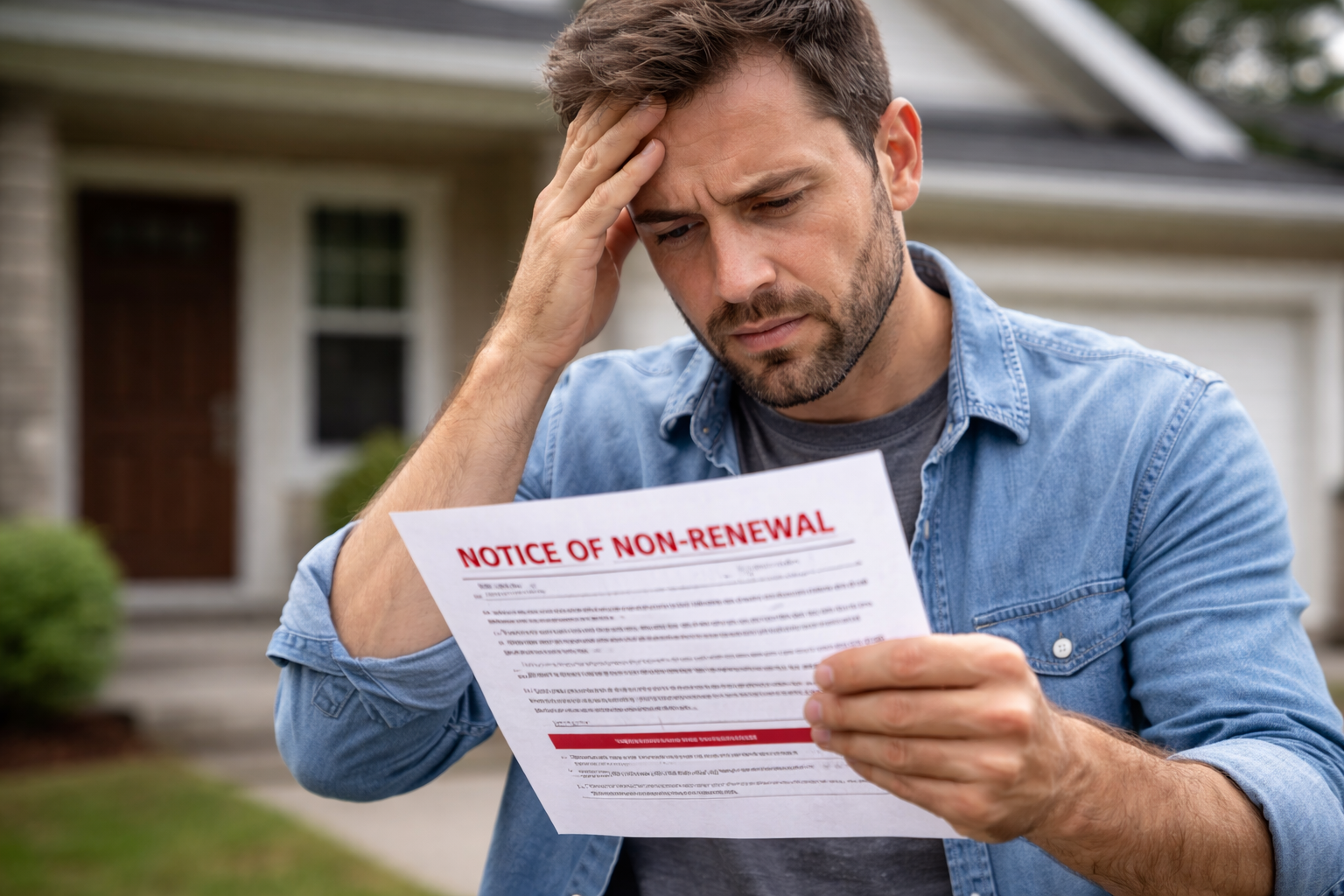
There is perhaps no piece of mail more anxiety-inducing for a modern homeowner than the thin, formal envelope containing a "Notice of Non-Renewal." In the volatile insurance landscape of 2026, these notices are flying out of underwriting offices at a record pace. Major national carriers like State Farm, Allstate, and Farmers are aggressively "de-risking" their portfolios, systematically pulling out of entire zip codes in California, Florida, Texas, and even previously "safe" regions in the Midwest and Northeast.
If you have received one of these letters, your first reaction is likely a mix of panic and confusion. You may have paid your premiums on time for a decade and never filed a single claim, yet the company you trusted is effectively firing you as a customer. The immediate stakes are high: if your insurance coverage lapses, your mortgage lender has the legal right to purchase "Forced-Place Insurance" (also known as Lender-Placed Insurance or LPI) on your behalf. This is a catastrophic outcome for your finances. Forced-place insurance typically costs 400% to 600% more than a standard policy, protects only the structure (the bank's collateral), and provides zero liability coverage for you and zero protection for your personal belongings.
This exhaustive guide is your emergency response plan. We will move beyond the initial shock to provide a calm, technically grounded, and strategic roadmap. we will explain why insurers are making these moves in 2026, decode the "Blackbox" data reports that determine your insurability, and provide a week-by-week survival checklist to secure a new policy before the clock runs out. Whether you were dropped for wildfire risk, a 15-year-old roof, or "claims frequency," there is a professional path forward.
Part 1: The Underwriting Autopsy—Why Were You Dropped?
Before you can solve the problem, you must identify the root cause. Insurance companies are legally required to provide a reason for non-renewal, but the language used is often intentionally vague, such as "Change in Underwriting Appetite" or "Concentration of Risk."
To find the truth, you must understand the four primary drivers of non-renewal in 2026:
1. The "Reinsurance" Squeeze (Concentration of Risk)
This is the most common reason for non-renewal in 2026, and it has nothing to do with you personally. Insurance companies buy their own insurance, called "Reinsurance," to protect them from catastrophic years. Reinsurers have dramatically hiked prices and told primary carriers: "You have too much money at risk in this specific coastal or wooded zip code. If one hurricane hits, you will go insolvent. Drop 20% of your customers there, or we won't insure you." In this scenario, you are simply a number in a math problem.
2. The "Eye in the Sky" (Property Condition)
As we discussed in our guide to AI and predictive modeling, insurers are now using high-resolution satellite imagery and drone flyovers to perform automated property inspections. AI algorithms can detect moss on shingles, overhanging tree limbs, peeling paint, or even a new trampoline or pool that wasn't on the original application. If the AI flags a "maintenance hazard," the system automatically triggers a non-renewal.
3. The "Claims Frequency" Red Flag
Statistically, a homeowner who files two $1,000 "nuisance" claims for a small leak is a much higher risk than a homeowner who files one $100,000 claim for a lightning strike. Frequency indicates a lack of preventative maintenance. In 2026, many carriers have a "Two Strikes" rule: two paid claims of any size within a three-year window result in an automatic non-renewal.
4. The "CLUE" Report (Your Insurance Credit Score)
Every interaction you have with an insurer is recorded in the Comprehensive Loss Underwriting Exchange (CLUE) database. This report follows you and your property for seven years. Even if you called to ask about a potential claim but never actually filed it, it may show up as an "Inquiry," which some aggressive underwriters treat as a loss event.
Action Step: Call your current agent and demand the "Underwriter's Memo." Ask specifically: "Was this a physical property issue I can fix, or a corporate decision based on my zip code?" If it's a physical issue, you have the power to reverse it.
Part 2: The 30-Day Countdown Checklist
Most states require insurers to give you 30 to 60 days of notice. This is your "Golden Window." If you wait until the final week, you will likely be forced into the Insurer of Last Resort market, which is significantly more expensive.
Week 1: Data Gathering and Correction
- Order Your CLUE Report: Visit LexisNexis and request your free annual disclosure. Review it for "Ghost Claims"—losses that belong to a previous owner or claims that were denied but are listed as paid.
- The Dispute Play: If you find an error, file a formal dispute with LexisNexis. An error on your CLUE report is the #1 reason for a "declined" application with a new company.
- Contact Your Mortgage Servicer: Do not wait for them to find out. Tell them you have received a non-renewal and are actively shopping. This builds a "Good Faith" record and may delay the start of the forced-place insurance process.
Week 2: The Broker Strategic Pivot
- Move Beyond the "Captive" Agent: If you are currently with a captive agent (State Farm, Allstate, Farmers), you must realize their hands are tied. They only represent one company.
- Find a High-Volume Independent Broker: As we detailed in our guide to Captive vs. Independent Agents, you need a broker who has appointments with 30+ "Admitted" carriers and, crucially, access to the "Wholesale" or "Surplus Lines" market.
- The "Shadow Quote": Ask the broker to run your property through a "Replacement Cost Estimator" first. As we noted in our analysis of the inflation trap, if your current coverage limit is too low, new companies will reject you for being "underinsured."
Week 3: The Mitigation Blitz
If your non-renewal was due to property condition, you must act like a professional risk manager.
- The Roof Gamble: If the roof is over 15 years old, most standard companies will say no. If you can afford it, replace the roof this week. A brand-new roof with impact-resistant shingles makes you a "Preferred" risk again, even in a high-wind zone.
- Vegetation Management: If you live in a wildfire-prone state, clear a 100-foot "Defensible Space" around your home. Remove "ladder fuels" (bushes under trees).
- The Proof of Repair: Once the work is done, do not just tell the broker. Send high-resolution, dated photos and copies of the contractor's paid invoices. These "Proof of Mitigation" documents allow a broker to bypass the AI filters and get a human underwriter to look at your file.
Week 4: Securing the Binding
- Bundle Everything: In 2026, insurance companies "hate" standalone homeowners policies. The only way to get them to take a risk on your house is to give them your auto and umbrella policies as well. Bundling is no longer just for a discount; it is often a requirement for eligibility.
- Prepare for the Physical Inspection: The new company will send an inspector. Ensure your gutters are clean, your yard is tidy, and there are no "trip hazards" on your sidewalk.
Part 3: Navigating the "Insurers of Last Resort"
If the standard "Admitted" market (companies like Travelers, Safeco, or Nationwide) still says no, you have reached the secondary market. This is a complex tier of insurance that requires a different strategy.
1. The Surplus Lines (E&S) Market
These are private companies (like Lloyd's of London, Scottsdale, or Lexington) that are "Non-Admitted."
- The Strategy: They are not bound by state rate caps, so they will say "yes" when others say "no," but they will charge you for the privilege.
- The Risk: There is no "Guaranty Fund" backing. If the company goes bankrupt, the state won't pay your claim. Always check their AM Best Rating; you should only accept a carrier with an "A" (Excellent) rating or better.
- The Cost: Expect a premium that is 50% to 150% higher than your old policy.
2. The FAIR Plan (The State Pool)
As we explored in our deep dive into FAIR Plans, this is the true bottom of the safety net.
- The "Named Peril" Trap: Most FAIR plans only cover Fire, Smoke, and Lightning. They do not cover theft, water damage, or liability.
- The Mandatory "Wrap": If you are forced into a FAIR plan, you must buy a second policy called a Difference in Conditions (DIC) policy. This "wraps around" the FAIR plan to provide the liability and theft protection you need to satisfy your mortgage and protect your net worth.
Part 4: Financial Engineering—Making the High-Risk Rate Affordable
If your premium just jumped from $2,000 to $6,000, you need to use "Risk Engineering" to stop the bleeding.
- The Catastrophe Deductible: This is the most effective lever. Move your deductible from $1,000 to $5,000 or $10,000. As we argued in our Ultimate Guide to Deductibles, you are no longer insuring for "inconveniences." You are insuring against "ruin." A high deductible can drop a surplus lines premium by 30-40%.
- The "Actual Cash Value" (ACV) Roof Compromise: If your roof is old, ask for an ACV Roof Endorsement. The insurer will pay less if the roof is damaged by hail, but they will often lower the base premium significantly in exchange. This is a calculated risk to protect your overall home equity.
- Install an Automatic Water Shut-Off: As we detailed in The Silent Water Crisis, installing a device like Flo by Moen can trigger a "Protective Device" credit that is often 10% or more. In the high-risk market, 10% can equal $600 in savings.
Part 5: The "Bounce Back" Plan—Reclaiming Preferred Status
Being non-renewed is a temporary season, not a life sentence. The insurance market is cyclical.
- The 3-Year Claims-Free Goal: If you were dropped for claims history, your #1 priority is to stay claim-free for 36 months. After three years, the most punitive "Surcharges" drop off your CLUE report, and you will likely become eligible for standard "Admitted" carriers again.
- Aggressive Annual Auditing: Do not get "lazy" with your high-risk policy. Every year, 60 days before renewal, perform an annual insurance audit. Ask your independent broker to "re-shop" the market. As interest rates move and inflation cools, a company that rejected you last year may have a "New Business" appetite this year.
- Home Hardening as an Asset: View the money you spent on tree trimming and roof replacement not as an expense, but as an investment in your "Insurability Profile." A hardened home is a liquid asset; a home that can't be insured is a home that can't be sold.
Part 6: The "Forced-Place" Warning (Lender-Placed Insurance)
If you fail to provide proof of insurance by the expiration date, your lender will "force-place" a policy. Do not let this happen.
- The Cost Math: If your mortgage payment is $2,500/month, a forced-place policy can add $1,500/month to that bill. This often leads to "Escrow Shortages" that can cause your mortgage payment to double the following year.
- The Occupancy Gap: Most forced-place policies are "Vacant" forms. If you are living in the house and it is destroyed, the lender might use the "Residency" clause to deny the claim, leaving you with nothing.
Conclusion: Clarity is Your Only Shield
The non-renewal crisis of 2026 is a reflection of a world in transition. The combination of climate volatility, construction inflation, and high-speed data has changed the rules of homeownership. You can no longer be a passive participant in your insurance contract.
If you have received a non-renewal notice, you must transform into a proactive risk manager. Understand your CLUE report, find an independent broker who understands the surplus lines market, and be prepared to invest in your home’s physical resilience.
At Surety Insights, we believe that Knowledge is the Only Unsinkable Shield. A non-renewal notice is not the end of your homeownership journey; it is an invitation to professionalize your protection. Take a deep breath, follow the roadmap, and secure your future. Your home is your most valuable asset—make sure it is protected by a policy you chose, not a policy forced upon you. Drive safe, audit well, and stay covered.
Share this article
About the Author
Adams Kotel
Lead Insurance Analyst
Adams has over 15 years of experience in the insurance industry, specializing in personal line products. He is passionate about demystifying complex insurance topics and helping consumers make educated decisions.
Related Articles

How Much HO-6 Dwelling Coverage is Needed for a 2,053 Square Ft Condo? (A Mathematical Case Study)
Calculating condo insurance isn't a guessing game. We break down the exact math for a 2,053 sq ft luxury condo, explaining "Coverage A," local construction costs, and the dangers of underinsuring a high-end unit.
Adams Kotel

The HO-6 Policy Training Outline: A Masterclass for New Condo Owners
An structured, step-by-step training outline designed to take you from a condo insurance novice to an HO-6 expert. Learn to decode master policies, calculate coverage, and protect your equity.
Adams Kotel